Advent, Day 7: Today

Cross Stitch by Grandma Currie

And Zechariah said to the angel, “How shall I know this? For I am an old man, and my wife is advanced in years.” And the angel answered him, “I am Gabriel. I stand in the presence of God, and I was sent to speak to you and to bring you this good news. And behold, you will be silent and unable to speak until the day that these things take place, because you did not believe my words, which will be fulfilled in their time” (Lk. 1:18-20).

The days were tired. Evening never came soon enough.  It’d been a long life under Roman rule. It’s not that Zechariah and Elizabeth were ready to die. It’s just that they weren’t ready to start a new life. It was time to slow down. They were at peace with God, they’d lived faithfully (cf. Lk. 1:6), and the burdens of the priesthood would soon be carried out by the next generation. Zechariah had spent these latter years training up young priests, seeing in their faces the son he never had. He’d already grieved that unanswered prayer. And then God answered it (Lk. 1:13).

God answers prayer in his timing, which is to say, not in our timing. Luke points out that Elizabeth and Zechariah were both “advanced in years” (Lk. 1:7). That’s another way of saying, “…too old and achy to even be thinking about having children.” They were at the age when you’re supposed to be able to spoil children, not raise them, to shake them up like a can of soda and give them back to their parents. But they were about to be the parents. And they were old. 

By this time, Zechariah’s mind was no doubt made up about a few things. He knew that the world’s treasures were peddled in smoke and mirrors and that human innovations usually amounted to new packaging of the same old empty promises. When he was young, life was charged with possibility. His favorite book of the Bible was Joshua. People had called his generation the “Joshua generation.” But he eventually realized that every generation gets called that. It probably has something to do with hope, maybe also regret. 

Truth is, Zechariah had long given up on that naïve faith in the future, or at least that a new future could begin today. His favorite book now was Ecclesiastes. It resonated. It’s not that he had lost faith in God. Indeed, he had faith the strength of an old growth forest, unmovable by the winds of change. It’s just that sometimes God is in the Wind (cf. Jn 3).

Are you sure you’ve got the right address? Zechariah says, in effect, to the angel Gabriel: “How shall I know this? For I am an old man…” (Lk. 1:18).

Gabriel is annoyed.

“I am Gabriel. I stand in the presence of God…” (Lk. 1:19). How will you know? You will know when an angel who stands in the presence of God comes and tells you. That’s how you’ll know! 

So Gabriel shuts his mouth.

It is impossible to know why Zechariah doubted or exactly what the nature of the doubt actually was. Age was certainly a factor. But it seems to be about more than just a question of fertility odds. Gabriel said that his son would “be filled with the Holy Spirit…and come to turn the hearts of the fathers to the children…” (Lk. 1:15-17). Zechariah was a priest. He knew where that line came from. It’s the very last line of the Old Testament (Mal. 4:5-6), which, for Zechariah, was not yet “Old.” It was just kind of….“on hold.” For it to become “Old” would require a number of certain promises to be fulfilled, and Gabriel had just told him that the first of all (cf. 2 Cor. 1:20) those promises was about be fulfilled in his elderly wife’s womb. And if that were being fulfilled, everything was about to be fulfilled.

Could that really happen…today? 

Perhaps.


Zechariah had spent his entire life learning how to believe that God’s promised future would happen—in the future. We all think Jesus is going to come back in the future, but I imagine we’d be just as surprised as Zachariah if that future arrived today. Well, that’s what happened to Zechariah. Maybe the Joshuas of the world are ready for a revolution today, but today Zechariah would do well to have his knees replaced. He identifies more with Methuselah than with millennials.At this stage, it’s time to settle down and begin letting go, trusting that God will fulfill his promises in some distant tomorrow. But God is no respecter of day-timers. Retirement would have to wait. Tomorrow was at hand.

For nine months this teacher of the Law will be unable to speak. He’ll have more ‘quiet time’ than usual, to say the least. Maybe he’ll start reading Joshua again. Now mute, he’ll have to be removed from any ordinary social roles. More importantly, his priestly duties—teaching the Covenant, service at the altar, temple staff meetings—all those things will have to be put on hold, because all those things are now growing “Old.” 

It’s no wonder that when he does open his mouth for the first time after nine months it is no longer as a priest but as a prophet. Priest’s were echoes of Israel’s past. Prophets were bullhorn’s of Israel’s God, who always speaks in the present tense. 

“Zechariah was filled with the Holy Spirit and prophesied, saying…” (Lk. 1:67ff). 

And out came in concentrated form the announcement that all of God’s promised future was at hand (Lk. 1:67-79). The entire priesthood would henceforth be silenced, because a Lamb was coming prepared for the slaughter, and He would need no assistance at the altar (cf. Heb. 7). The old institutions were passing away, behold the whole world was becoming new (cf. 2 Cor. 5:17).


It’s easy to believe in the God of yesterday, it’s easy to believe in the God of tomorrow, but it’s hard to believe in the God of today. It’s hard to believe that God will speak today, act today, answer prayer today, change our hearts and our habits and our homes today. But God will always, and will only, work in our lives and in our world today.

“Today, if you hear his voice, do not harden your hearts…” (Heb. 3:7, 15).

Even the day Christ comes back will be a today like any other—until it’s unlike every other. If you only ever expect Christ to come back some distant tomorrow, or even the next tomorrow, you may never learn how to listen and look for the way Christ is showing up every today. Are you expecting Christ to come today?

“Behold, now is the favorable time; behold, today is the day of salvation” (2 Cor. 6:2).


Lo, in the silent night
A child to God is born
And all is brought again
That ere was lost or lorn.
Could but thy soul, O man,
Become a silent night!
God would be born in thee
And set all things aright.

~ Author Unknown

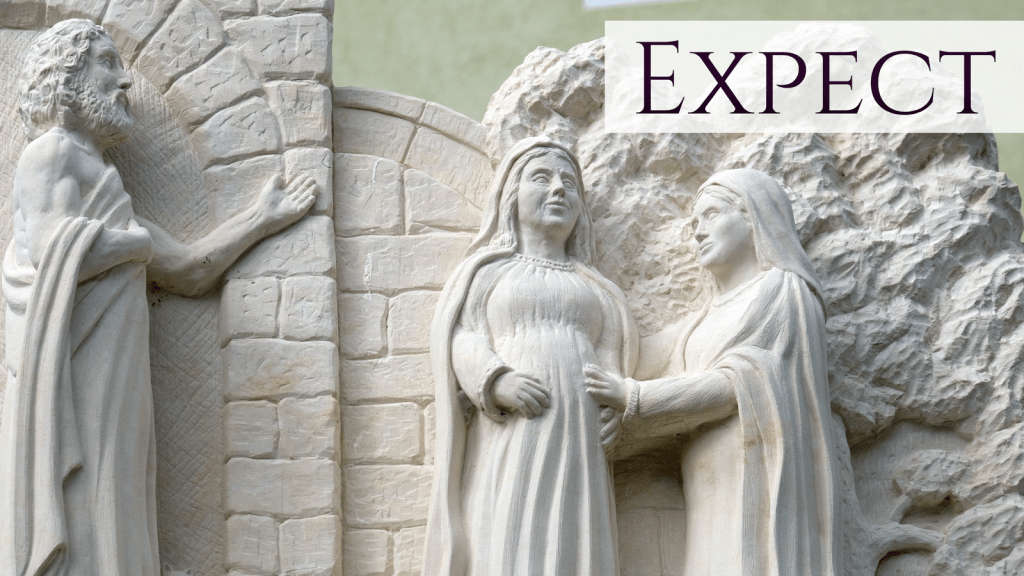
Advent, Day 6: Expect

“And an angel of the Lord appeared to Zechariah, standing to the right of the altar of incense. Zechariah was troubled when he saw the angel, and fear gripped him. But the angel said to him, ‘Do not be afraid, Zechariah, for your prayer has been heard, and your wife Elizabeth will bear you a son, and you will give him the name John” (Luke 1:11-13).

They’ve been waiting. They’ve been remembering. They’ve been preparing. And now they are expecting.

But let’s be honest, this wasn’t expected (hence Lk. 1:18-20). Even though it was an answer to prayer (cf. Lk. 1:13), it wasn’t one of those prayers you really expect God to answer, like a ‘traveling mercies’ prayer, or that wildly daring one about food being miraculously transformed into “the nourishment of our bodies.” This was a specific prayer. That’s the kind of prayer that leads to trouble, because as soon as you start asking God for specific things to happen, especially things that don’t ordinarily happen, you then run the risk of God specifically saying no. Specific prayers are fighting prayers.

Keeping our prayers generic helps us preserve a professional distance. Nobody’s personal space is violated. Nobody has to expect much from anyone. Praying for God’s will to be done in Elizabeth’s life is one thing, but praying that God would put a baby into Elizabeth’s barren womb is quite another. The answer—yes or no—is empirically verifiable. Everyone’s personal space is violated: God’s, Elizabeth’s, and the one standing in the gap between them trying to build a bridge between heaven and earth. Prayer like that knows no social boundaries. That’s why most of us don’t pray like that. We’d rather just agree to live parallel lives and avoid the discomfort that often comes at the intersection.

God answers prayer. God does not answer prayer. Both statements are true.

Word it however you want to try to soften it or stick up for God—“God answers every prayer, just in ways we don’t understand”—but that does no good. That’s just an excuse to never look God in the eye. Sometimes God’s response is precisely no response. Sometimes the Truth is revealed in the eyes of Silence. Just ask Pilate (cf. Jn. 18:38).

Nor is it true that if a prayer hasn’t been answered the problem is the faith of the praying person. The problem is that God didn’t answer the prayer. The only thing worse than people who smear every prayer into an enigmatic “yes” are those who lie about the unambiguous “nos.” I’ve heard people talk about prayer as something that only needs to be “claimed,” as though God had no say in the matter, as though God were not a living and active and real Person, as though God were not free. I’ve even heard people lie about God answering prayer. I’ve seen ministries based on that lie. Those ministries are not about God acting. They are about people acting like they are gods. They are about people reaching up into heaven’s treasury and grabbing whatever the hell they want—if only their faith is tall enough. But human faith gets little larger than a mustard tree. And sometimes God doesn’t answer prayer. People who say God answers every prayer are people who have never prayed.


But Zechariah prayed. And he prayed at the intersection. That’s where my mother prays too. Zechariah prayed for a son to be born who could not be born. Elizabeth was barren. My mother prayed for a son to be found who was irreversibly lost. No enigmatic yesses were possible. God would answer her prayer or God would not. And for at least twelve years, from the volatile ages of 10 to 22, he did not.

I was recently preparing on a sermon about the way people are led to faith through the faith of others (cf Mk. 2:1-11), so I texted my mother (because that’s what sons do when they need something from their mothers—they text them) and asked her what it was like “when your family was going to hell in a hand basket. Please email response.” Below is an excerpt from her response:

Subject line (all caps): “NEVER CONSIDERED FOR ONE SECOND ‘TO HELL IN A HAND BASKET’” (reprimanding tone noted).

As our third, we weren’t really expecting you, and since you weren’t part of our plan, I knew you were part of God’s plan. That is, I knew God wanted you more than I did. So, while I was extremely concerned, sad, and experienced many sleepless nights, I never really landed on the thought you would be lost. My prayer life deepened so much during that time to the point of wordless groanings and moanings too deep to be uttered (Rom. 8). But I knew God was faithful…

The curious thing about my mother’s unanswered prayers is that they did not have a distancing effect but a deepening effect. With each unanswered prayer she dug down deeper into God’s heart, so as to say, “Fine. Then I’m moving in—and I’m bringing all my burdens and my baggage with me. And I’ve got A LIST of names!” Her prayers moved from trusting to entrusting. She stormed into the heart of God and drug my name with her day after day after day. I tried my hardest to go to hell, my mom just wouldn’t let me.

I once heard my father in-law say, “Even when you don’t see the hand of God, you can always trust the heart of God.” The only people who say things like that are people who actually pray, because they know the hand of God has a mind of its own. But ordinarily a person’s heart can only be seen through their hands, for hands are expressions of the heart. But this or that answer to prayer can never communicate the depths of God’s heart. And it may threaten to bring us to look only for God’s hand. 


That’s what happened to the Exodus generation. They starting out “groaning” into God’s heart (Exod. 2:23-25) and quickly ended up “grumbling” at God’s hand (Exod. 16). They cried out for freedom and God “brought them out of Egypt with a mighty hand” (Dt. 26:8). But rather than being drawn closer to God’s heart they got addicted to his hand. After he gave them freedom from Egypt they began to turn on him because he wouldn’t give them food from Egypt. They had apparently forgotten the cost of “the fish we ate in Egypt that cost nothing” (Num. 11:5)–it was the cost of freedom. Pharaoh wanted to keep meat on those temple-building bones. 

So God reserves only one place his hands can forever be called the perfect expression of his heart (Jn. 1:18). It’s the one place he commands everyone to look to see his heart right through the holes in his hands (Rom. 5:8). It’s at the intersection, where Christ closed all the gaps. That’s where God prays. (Lk. 23:34).

Prayer, then, is intended to draw us closer to the God whose heart is revealed in the cross of Jesus Christ. The cross is like a tuning fork for our prayers. A tuning fork is tuned to only one key. It will vibrate if it gets close enough to something else vibrating in the same key. This is called resonance. St. Augustine once said, “You have made me for yourself, O Lord, and my heart is restless until it finds its rest in you.” He was talking about resonance.

Whether it knows it or not, the human heart is trembling in its longing for a gracious God. That trembling feels like fear, and it should, if in fact God is God and we have sinned against him. And, in fact, he is and we have. That revelation can change the way to think about your next breath. For it is indeed “a fearful thing to fall into the hands of the living God” (Heb. 10:35). But, it turns out, the cross is the place where trembling sinners find resonance with a terrifying God, because it is there they discover grace, amazing grace indeed. 

Twas grace that taught my heart to fear
And grace my fears relieved
How precious did that grace appear
The hour I first believed

God has one Word to so say to this world, and he wrapped It in swaddling flesh to say it (Jn. 1:14-17). In so doing, that enfleshed Word became receptive to God on our behalf. In Christ, we are tuned to the key of God. But this is not a new note. It was just hard to hear the heart of God before Jesus came. But David heard it. David’s salvation didn’t come by asking God “into his heart.” It came by storming his way into God’s heart. David took up residence there. Where else could he go? The Law condemned him. But God didn’t. That’s why you can hear the Gospel resounding before it even sounded in Psalm 51. Resonance.

God uses prayer to bring us close enough to himself that our hearts get in tune with his, because that’s how he changes our hearts. He shakes the grace into us. In time, it’s the life of prayer itself that proves God is gracious and can therefore be trusted with everything, indeed that we can entrust everything to him. Even a wretch like me (and you) has found a place right at the center of God’s heart, held firmly in the holes in his hands. We come to know God’s heart when we resolve to bury ourselves inside it, baggage and names in tow. The more time we spend with him, the more we know his heart, the more we know we’re all in good hands.  Even when the answer is still no, even if I am being marched to the sepulcher, even when the sun forebears to shine—Even so…Amen.


But then, one day, God answers—because God does answer prayer—and the circumstances are changed. Zechariah’s world is changed. Elizabeth is expecting. And frankly, he wasn’t really expecting it. But we’ll deal with that tomorrow. 

For now, amen.

Advent, Day 4: Barren

[Zacharias and Elizabeth] were both righteous in the sight of God, walking blamelessly in all the commandments and requirements of the Lord. But they had no child, because Elizabeth was barren, and both were advanced in years.
–Luke 1:7

Barrenness is of course a fertility problem. Biologically it refers to a womb that cannot support embryonic life. Agriculturally it refers to a land that cannot support plant life. Metaphorically it proves to be a rather mutable word. It was a favorite of the Victorian poet Alfred Lord Tennyson, who spoke of barrenness in a number of applications: barren efforts and barren shores and barren crags and barren lives and ultimately of a barren Death:

Wiser there than you, that crowning barren Death as lord of all,
Deem this over-tragic drama’s closing curtain is the pall.

Lord Tennyson is right. Barrenness finds its way into every nook and cranny of this world and our experience of it. And that is because theologically barrenness is the state of creation this side of exile, the world East of Eden. God’s good world of Genesis 1 & 2 had already gone to seed under the stewardship of his image-bearers in Genesis 3 (cf. Gen. 1:26-28). And now we live, it seems, in two worlds, God’s world and our world, a world of good and evil.

The world is thus duplicitous in its barrenness and beauty, its grandeur and terror, its tranquility and violence, its capacity to provide for the unseen sparrow and its capacity to turn to ice. We can neither escape the echoes of heaven nor the shadows of hell. Creation is groaning in both labor and suffocation, new births and burials by the minute, a sign (that is more than a sign) that Mother Nature is ever losing her battle with Father Time. Every birth certificate already shares its name with a death certificate. We live in a world and in bodies and in communities that simply cannot adequately support life.

Every home, so rich with memory, will slowly grow empty and eventually the nest will be left all alone. No more children giggling their way into the master bedroom on Saturday morning. No frenzy of life in the kitchen on Thanksgiving Day frantically filling every dish and basket and platter with an attempt to keep the past alive. No one to say “Mom” or “Dad” or “You’re grounded!” or “Pass the jam”–-just the occasional “Mr.” or “Mrs.” when the phone rings. Then calls come only for “Mrs.”, with condolences. Then the phone just stops ringing. Life inside the walls gives way to a damningly exact proportion of grief. But soon no one is even left to cry. What was once home to a family will eventually house only an empty memory, maybe a few moths. The world is our womb, and it is barren, every life a miscarriage.


But there is something hopeful in all this, because we were not created to live in such a duplicitous world and to be such duplicitous creatures. The world was made to be good and we were made to be like God (Gen. 1). Would we really want God to preserve everything as it is, when the world is full of evil and we are full of godlessness, when nature is amuck with “natural” disasters and we will all die of “natural” causes, unless something “unnatural” kills us first? Would we not rather God burn the evil away and flood the void with light? Perhaps the sign of the times, then, is not that death is the conclusion to all human life but, more precisely, that death is the conclusion to all human evil. Indeed, “the wages of sin is death” (Rom. 7).

But our sin and death has not deterred God from finishing what he has started. He is still committed to making the world to be good and making us to be like God. We just have to be emptied of life, such as it is, before we can be filled with life as it will be. Nobody plants flowers in a bed of weeds or a thicket of thorns. Before there can be new life, there must be death. In this way, barrenness is about new beginnings.


Barrenness is not only the state of things after everything dies. It is the state of things before everything lives. Indeed, a womb must be empty before it can be filled with life, just as creation was formless and void before it was filled with light. But God not only filled the void, he created it (Gen. 1:2). He did not just hurl the world into a space sufficient to sustain it. He created it as a barren womb, a space he would himself have to fill in order for it to be filled with Life. Apart from him this world would only inevitably return back to its original, all-consuming barrenness, but this world is not apart from him—because Christmas. Because God was born into this world, this world can be born again. Our barrenness is not a post-apocalyptic wasteland but the womb of new creation. Emmanuel—east of Eden.

I used to think, wherever you find Jesus, there you will find no misery. But I’ve learned over the years it’s just the opposite: Wherever you find misery, there you will find Jesus. He says as much in some rather harrowing words about the sheep in his fold and goats in high places (Mt. 25). Emmanuel means God has come to us in all the barrenness of our exile, not that we have gone to him in all the grandeur of his celestial paradise. We will never find God in heaven because God has found us on earth, and it is here that heaven is coming (Rev. 21-22): here, in barren places; here, with broken people; here, where God is.


And it has always been so. God comes where the efforts are barren and the ground is chapped. Slaves in Egypt became a nation in the desert. God had come. Out of barren wombs the child of promise is born to Sarah, the child of prophecy to Elizabeth, the “Voice crying out in the Wilderness” born to a father who could not speak. God had come. Out of nowhere the substitute came to Abraham for his son on Mount Moriah. Out of the Virgin the Substitute came to Israel for all sons on Mount Calvary. God has come.

And God is coming again. Isaiah says we’ll know it is God because the cracked desert floor will begin blooming like a daisy field in springtime; the groaning ground of the curse will suddenly burst into song (Isa. 35). Scorched war fields will become spring-fed gardens (Isa. 58); swords and spears will be beaten into the shape of life and kept in the barn (Isa. 2). He said that lions and tigers and bears would go vegan and siesta with lambs and yearlings (Isa. 11). There will be life where there could otherwise be no life, peace in a world of unrest, a symphony filling canyon winds. Paul says we’ll know it is God because when he comes he will lay death down to sleep, pray the Lord its hell to keep. We’ll wake up one day without aching joints and pressing deadlines. We’ll see mirrors we’re not ashamed of (1 Cor. 15).

John says we’ll know it is God because of what happens to the brokenhearted. The little boy whose dad was sent home in the form of a flag, the young mother of that boy looking helpless at his searching eyes; the little girl who never wore white. We’ll know it is God not because the brokenhearted will suddenly stop crying but because their tears will be wiped away (Rev. 21:4). They will be touched by a real Hand and there will be a resurrection of real hands. Those searching eyes will find what they never stopped looking for. It will be like a world ruled by the real religion that James talked about (Ja. 1:27).

John also says we’ll know it is God because it will be like a Bridegroom and a Father and a Son and like a world full of siblings (Rev. 21-22), like wedding reception and a family reunion all at once (Rev. 19:6). It will just be a mess of an overflow. Loneliness won’t fit in even a crack on the floor. There will be no storm shelters or panic rooms, no sirens or seatbelts, no temples or mosques—“And I saw no temple in the city, for its temple is the Lord God the Almighty and the Lamb” (Rev. 21:22)—no closed countries of fleeing families—“for the kingdoms of the world have become the kingdom of our Lord and of his Christ, and he shall reign forever and ever” (Rev. 11:15)—no abortions, no greed or grudges, division or divorce, no partisanship, no voting booths, no border patrol, no propoganda, no child soldiers, no father soldiers, no midnight calls, no shame, no shadows, no more goodbyes: only God, only Light, only peace, only joy, infinite joy drowning the void beneath the weight of the “glory of the Lord that fills the earth as the waters cover the sea” (Isa. 11:9; Hab. 2:14), and us—with a Table there at the center to keep the past alive for good (Rev. 21:21-23).

When Christ comes, he comes to dethrone the one called “barren Death” crowned “lord of all.” The crimson of his crown will touch every tomb and burst forth in a bloom of roses. For He is the “firstborn of creation” (Col. 1:15) and therefore the “firstborn of the dead” (Col. 1:18). And he will again descend into this barren womb of creation, this time to bring forth life in an unbound abundance. When “the Lord descends from heaven…the dead in Christ shall rise” (1 Thess. 4:16). And on that day, the world will be discovered as an ultrasound devoid of any dark, as we all are born again into the womb of eternal life, together with the eternally Begotten Son of God. No more miscarriages.

When he comes—he is coming!