“Glory to God in the highest, and on earth peace among those with whom he is pleased” (Lk. 2:14).
Other than a few proper names, there is no word in my vocabulary more important to me than the word peace. I suppose it is because for a long time I lived without it. Anyone whose world has been stripped of peace knows just how much it’s worth.
But defining peace is nearly impossible. This is evident the moment you try to think of its opposite. There’s happy and there’s sad. There’s hope and despair. There’s joy and sorrow, good and evil, heaven and hell, dogs and devils I mean cats. But what is the opposite of peace? Is it war or is it worry? Is it Hostility? Restlessness? Angst? Anxiety? Fear? Bitterness? Hatred? Rage? Violence? Revenge? Discord? Division? Divorce? Chaos? Where is peace essentially located, or not? Is it in the heart or in relationships or in nations or between nations? Is it within or without? Is peace the natural state of affairs or do we, and does our world, default to its opposite, whatever that opposite may be at bottom?
Peace is such an all-encompassing word that there is no single word that can describe what it is like not to have it. Nor is it clear how to get it. There are no guaranteed paths that lead to peace, even though everyone is searching for it in one way or another, or perhaps running from its opposite, but there simply is no predictable profile of a person who has it or does not. We may have all been able to guess that Kurt Cobain struggled to find peace, but Robin Williams? Those at the top of the ladder are just as potentially bankrupt as those at the bottom.
Perhaps, then, there is no definitive opposite of peace to speak of, only its definitive absence. It is surely the case that no matter how many things a person might have, to have no peace is in a certain sense to havenothing. I do not mean tonot have anything but to have precisely nothing: an inescapable void right at the center of everything else, like the billions of stars in our galaxy that all have a supermassive black hole churning at the center. It is indeed the absence of peace that sets much of our world in motion, into commotion. Everyone is searching for its presence (or running from its absence) but more often than not search (or run) in vain. The absence of peace cannot be filled with any substitute presence any more than a black hole can be filled with starlight. It’s almost like the absence of a person. The only thing that can fill the absence of a person is that same person’s presence. There is no replacement for peace.
In the Bible the absence of peace is, in fact, a personal matter. There is a hole in the heart of the world. God made the world to be especially present to it, in it. After breathing the universe into being and hanging the stars and planets up like nursery mobiles on natural laws, he picked one planet to fill personally with his presence. Apart from his presence “the earth was without form and void and darkness was over the face of the deep” (Gen. 1:2). The formless void is creation with no particular reference points, no special order, no governing Lord, like the raging storms of Jupiter or the searing surface of Venus. The laws of nature may be able to loosely hold things together but they cannot put life together in the least. Special attention is needed. A Person is needed to make persons. The world apart from God is utterly indifferent to life.
So God intervenes, bringing order and giving form, filling the void with his presence and human beings with his blessing, completing his work by entering with them into a state of rest (Sabbath) (Gen. 1:1-2:4). The world with God is utterly at peace. He had given dominion to human beings to govern the world in his image with his presence under his guidance. But they abused their power, seeking to become gods in their own image, and thus turned away from the presence of God (Gen. 3). It was not long before all creation all but returned to a formless void: “In the six hundredth year of Noah’s life…on that day all the springs of the great deep burst forth, and the floodgates of the heavens were opened” (Gen. 7:10-11). It wasn’t that God caused something unnatural to happen so much as it was that he allowed nature to take his course. He had separated the waters in ordering creation to make an oasis of life (Gen. 1:7). Judgment was simply a matter of withdrawing his sustaining hand.
And in the book of Revelation, the rider on the “fiery red horse” did not bring judgment by wielding his own sword. He was simply sent “to remove peace from the earth, so that men would slay one another” (Rev. 6:4). Men apart from God are utterly indifferent to life. The natural world and all that is in it defaults to chaos in God’s absence. There is no more terrible a prospect of God’s wrath than the withdraw of his presence.
Perhaps, then, peace does have a definitive opposite in that it does have a definitive absence. The opposite of peace is godlessness, in a literal sense. In the words of Karl Barth, “The enterprise of the No-God is avenged by its success.” So if you want to find peace, you have to go straight to the source. There is no replacement for God.
About five years back, Keldy and I were meeting regularly with a young gal helping her through some of life’s regulars, a few irregulars as well. One evening we had one of those rare “come to Jesus” moments, because it was pretty clear Jesus had come to her. There were tears, confessions, a white flag slowly being raised from her heart. But I could tell there was still some white in her knuckles as it related to one very destructive relationship she knew she needed to let go. I tried to convince her that staying in this relationship was like holding on to a ticking time bomb. I’ll never forget her response: “I’d rather die with someone who hurts me than be left alone. I just don’t want to be alone.” For this girl, it wasn’t a presence she feared, no matter how destructive, but an absence.
I can’t say that I blame her. I know what all sorts of pain feels like, and there is no pain that hurts more than loneliness. Indeed, “it is not good for man to be alone” (Gen. 2:18), so we would rather die with the ones who hurt us than be left to live alone.
But that’s not our only option.
A few years later I got a text from the same girl. It’d likely been a year since I had talked to her. She was off to college and I had, quite frankly, given up on her. But Jesus hadn’t.
I saved our conversation:
G: [Her opening line:] “I am ready to give my life to Jesus. I’m not sure what to do, so I need your help.” Me: “Did something happen? What changed?” G: “I was lying in bed in my dorm room, by myself, and suddenly I just felt at peace. It felt like my room filled up with peace.” Me: “What do you mean?” G: “I mean I didn’t feel alone anymore, and the only thing I could think about was Jesus.” Me: “Go and tell three people what just happened. I’ll call you tomorrow morning.”
Jesus has a special holiday Name: Emmanuel, which means “God with us.” The Gift of Christmas is the nothing less than the personal presence of God. The presence of God has come to us in the Person of Jesus Christ and comes to dwell within us in the Person of the Holy Spirit. Jesus himself said,
“The Spirit of truth…is with you, and he will be in you. I will not leave you as orphans; I will come to you…Peace I leave with you; my peace I give to you. Not as the world gives do I give to you. Let not your hearts be troubled, neither let them be afraid. You heard me say to you, ‘I am going away, and I will come to you…I have told you before it takes place, so that when it does take place you may believe'” (Jn. 14:18-29).
Jesus gives us his peace not as the world gives. That means, you don’t have to keep chasing empty promises and following false pursuits. Perhaps the best thing you could do is acknowledge the fact that you’re likely not running to something so much as you are running away from something. Perhaps you could face the absence square in the eye and fill the void with the Name of Jesus, calling on him to do what only he can do: to fill the absence in your life with the Person you are running from. There simply is no replacement for Peace.
For to us a child is born, to us a son is given, and the government will be on his shoulders. And he will be called Wonderful Counselor, Mighty God, Everlasting Father, Prince of Peace. Of the increase of his government and of Peace there will be no end” (Isa. 9:6-7).
“And while they were there, the time came for her to give birth. And she gave birth to her firstborn son and wrapped him in swaddling cloths and laid him in a manger, because there was no place for them in the inn….And in the same region there were shepherds out in the field, keeping watch over their flock by night. And an angel of the Lord appeared to them…and the angel said to them, “Fear not, for behold, I bring you good news of great joy that will be for all the people. For unto you is born this day in the city of David a Savior, who is Christ the Lord. And this will be a sign for you: you will find a baby wrapped in swaddling cloths and lying in a manger” (Luke 2:8-12).
A lot of people talk about “seeking God” as though on some open-ended quest toward an infinite horizon. But when the shepherds, who had just seen the infinite horizon rend with songs descending, were told to seek God, they were also told they would know they were on the right track when they received another grandiose sign from on high: a baby born in a barn.
Some sign…
Oddest of all— That God became small
We need to learn to become small again too.
Imagine how much bigger and more mysterious the world must have been before it got entangled in the World Wide Web, a world without Buzzfeeds that reduce our ordinary world to a series of tragic or trivial headlines and Newsfeeds that reduce our social world to a series of one-way conversations 140 characters-deep and 10,000 friends-wide. Imagine a world without Google Maps and Google Earth and Google Sky and Google Multiverse (forthcoming).
Imagine what it must have felt like to not feel like you are at the center of the earth or the center of every event and every relationship on earth. Imagine a world with board games and the great big woods outback.
Imagine—remember—what it feels like to be as small as a single man.
Our digital universe makes us feel bigger than we are. We have all-seeing-eye syndrome, miracle grow to an already deeply rooted god-complex, ceaselessly consuming newsfeeds from everywhere to everywhere, taking in the world with unprecedented immediacy and scope, continually finding ourselves having to form positions and make judgments on matters near and far, then and there, on events and outcomes, on catastrophes of both evil and “natural” sorts, on wars and rumors of wars, on futures warned and futures promised and futures feared, on systems of oppression and Whose responsible? and all the reasons I’m not, on the temperature and destiny of the earth, on the policies that should govern a global economy, on the measures taken—or decidedly not taken—in exercising military force in defense of our nation, or in warfare against the nations, and, on that note, on ancient demonic conflicts fought under revolving political pretenses over land and God and honor and greed and vengeance and envy and eschatology. We are in the know of whatever we want to know and the world feels like an extension of our collective, skyscraping fingertips. It is hard to be small when we’ve built the collective illusion of our bigness out of the brick and mortar of a subdued earth.
We are a great civilization, indeed, but we are building in the way of Babel, toward progress, not promise, toward a greater vision of ourselves, even trans-human, rather than God’s vision of us, rather than being conformed to the image of the Son. The notion of conformity violates our ethos of authenticity, since we persist in that age old habit of refusing to be made in God’s image and insisting on making him, and our world, in our own, as we have since Adam, in Adam (cf., 1 Cor. 15). Human civilization continues to advance through the shared will to “make a name for ourselves,” usually under the name of some leader’s or representative’s will, but decidedly not the will of God.
“Come, let us build ourselves a city and a tower with its top in the heavens, and let us make a name for ourselves, lest we be dispersed over the face of the whole earth.
—Genesis 11:4, The Tower of Babel
But all Babel’s towers are made to fall. God’s Word reveals history has a definite shape, that it is moving toward a definite end, but in this story history does take a cyclical shape precisely in kingdoms rising and falling, towers of trade reduced to tragic memorials, great coliseums left to erode in the wind like skeletal remains of the city’s ghostly soul. The higher a civilization ascends in its heavenly aspirations—cooperating according to a collective will severed from the will of its Creator—the farther and more immanent is its fall to hellish proportions. In Karl Barth’s words, “the enterprise of setting up the no-god is avenged by its success.”
In his Burnout Society, Byung-Chul Han describes the modern Western situation as one in which “everyone is an auto-exploiting labourer in his or her own enterprise. People are now master and slave in one.” He describes an epochal shift social imperative of the zeitgeist as one of a false liberation from a “disciplinary society” defined by prohibitions to “achievement society” defined by permission, from a “you shall not” society to a “be whatever you want to be.” This
“The achievement-subject stands free from external instances of domination forcing it to work and exploiting it. It is subject to no one if not to itself. However, the absence of external domination does not abolish the structure of compulsion. It makes freedom and compulsion coincide. The achievement-subject gives itself over to freestanding compulsion in order to maximize performance. In this way, it exploits itself. Auto-exploitation is more efficient than allo-exploitation [other’s exploiting you] because a deceptive feeling of freedom accompanies it. The exploiter is simultaneously the exploited. Exploitation now occurs without domination. That is what makes self-exploitation so efficient.”
Byung-Chul Han, The Burnout Society
Thus, we now band together primarily to build concrete towers of trade, not temples of human communion, working together to erect edifices that form our social infrastructure of atomization—nuclear fission at the nucleus of the human family—a society that cooperates to enable each member’s self-isolation. We’ve transformed human economy into a digital and materially deliverable faceless exchange of goods and services void of human connection.1 All we have to do is plug in to our respective devices, like rubber nipples in a milk barn, and “consume one another” (cf. Gal. 6) from a distance without ever being released from our stalls—without ever having to meet each other, much less share goods together or feast together or roast weenies together. We’ve transformed human society into a virtual domain in which egos can unite with likeminded ideologues across the globe without ever having to meet their neighbors, much less do the kind of “yard work” necessary to become a good neighbor. We’re forming into digital swarms of common angsts / enemies but have neither the public will to act nor the personal willingness to cooperate to do do anything constructive about it—beyond ongoing doom scrolling and digital engagement: all tribe, no village.
And as long as human civilization is busy building, keeping flashy projects and important “developments” flashing before our eyes, the grand illusion of human progress will continue to distract us from the immediate awareness of human transience, of earthly effervescence, of the inevitability of an end of all things that renders even steel towers as heaping castles made of sand. Our preoccupation in the arena of geopolitical struggle helps us avoid the angst of knowing it all ends in a geocosmic void, knowing that ultimately not one stone will be left upon another, knowing that there’s really no difference between a great city tower and a little mud hut—except perhaps the memories made therein—when you stand back and view them together in light of the whole. Zoom out to the edge of the universe, or as far as you can get just before we (the earth and everything in it) are invisible, and look: there we are, as Carl Sagan aptly put it, on “a mote of dust suspended in a sunbeam.”
“A Pale Blue Dot” from Voyager 1, Final Photo
See it? See us? See our tanks and our towers and our triumphs and our treasures? Me either.
And yet, being human—being that same creature that shares the image of the Creator, that shares life and relationship and eternity with the Creator—that is truly significant. But to remember that, we must become small again, we must learn how to become the small part of a big story, supporting character in a grand epic about the Son of God become Son of Man, as Emmanuel—God with us!
But it gets eclipsed by our own shadow. It’s hard to even remember what it felt like not to feel like I was at the center of the earth and the center of every event and every relationship on earth, what it felt like when the whole world didn’t seem like one grandiosely empty extension of my own digital ego
Imagine being as small as a single man?
Imagine being as small as God.
If Christians in America still care about making a kingdom impact on the world, and not just a social or political impact in America, it will be helpful to remember that when God saved the world, he became small. I find it hard to believe this was incidental, as though the Incarnation was just a means to an end to get on with God’s “bigger” plan of a global Christianity so that nations could be built on “godly principles” or “Judea-Christian” values (whatever that means). God became small and called us—commanded us—to descend humbly into smallness with him, and with the children, on pain of damnation (Mt. 18:1).
All our nation-building aspirations may be well and good, maybe, but they are not bigger than the revelation that God is a Person who became a Man who put his hands on babies and blessed them, who opened his arms and welcomed us into his family, forever. That’s wilder than the witches of Narnia, crazier than the genes of Percy Jackson. It means that to be human is to be caught up in the divine epic without end, and we may as well still be on page one. Our whole lives in this mortal flesh will be written, and concluded, on page one. All our family trees will splinter off or dry up or burn up, along with the earth (barring some ‘intervention’), on page one. All nations will rise and fall on page one. On the horizon of eternity, everything until the resurrection will come to its end on page one of this eternal epic. So perhaps we need to reconsider what matters most in this big story in which we have a small part to play. What will still matter in a few(?) trillion years, on page two?
It’s the little things. The little things will last. Heavens treasury isn’t filled with the stuff that fills our bank accounts and garages. The Bible says love will last. I guess that’s because people will last and hate will be incinerated. Love is the only thing that existed before anything else existed, the only Thing that will always exist, because God is love and created this universe as one grand arena for his love to be shared. So love will last, relationships rooted in God’s love will last forever. Investing in those relationships seems more transient than investing in real estate, but moth and rust can’t destroy memories in the mind of God. In the end, that’s all that will be left of anything. All creation will one day be a memory in the mind of God, so perhaps the question is What memories does God cherish? Great victories in battles? Political rallies? Family reunions? Family dinner? A mother looking down at the face of her newborn child?
What memories will heaven be made of?
God is not a principle, not even a set of “godly principles,” merely meant to be built on to hold up a nation or all nations like Atlas. He’s a Person, an eternal union of Persons—“God is love”—and the biggest plan of all, it turns out, was to reveal himself personally and unite little people like us into that great big eternal union of love with him. But love is limited in proportion to its capacity to be received. You can’t receive love from a god any more than you can receive love from a government. So God became small, because God so loved this little world that he so effortlessly holds up by the word of his power.
I think the whole idea of God becoming as small as a man was intended to keep men from trying to become as big as a god. Isn’t that what tripped us up in the first place (Gen. 3:5) and has continued to do so ever since the Fall (Gen. 11; Rev. 17-18)? I also think God becoming a Man is the great revelation that stubbornly bestows dignity to every man, every woman, ever child, even the children of our enemies. Moreover do I think that we are in the willful habit of forgetting this basic Christian fact, because it obviously means we should fire rockets at the least of these people with at least a measure of temperance, but probably instead with a terrible fear of God’s inexorable wrath and unrelenting fury, because there is a very real chance he may take it all personally—blowing up babies and the rest—as though what we do unto them we do also unto him. After all, he did become a baby before he grew as small as a Man. And when he was all grown up, not long before he was nailed down, he told us exactly what he would do to all the big people who beat up on all the small people when he comes back all Big again with the fires of hell in his hands (Mt. 25).
But until then, I think this idea of the smallness of God should be regarded as the rule that determines the means and methods of God’s global mission, so that while “Christianity” goes global it never becomes any less personal than Christ was—than Jesus is—himself, according to some bigger, grander, national Christendom project.
This is the troubling thing about people dragging Jesus’ name into political rhetoric, loading up Christian slogans like ammunition for culture wars and social activism. Maybe I’m just being willfully naïve, but I find it hard to believe that the living God who makes black holes and sustains the earth depends on us advancing his kingdom through our violent and compromised geopolitical strategies or culture war attacks.
Don’t get me wrong: I don’t think it is bad to be concerned with and aware of the global or national scene, especially when you are in a position to do something about it—most of the time, you aren’t—but I’m suspicious of a man who decries world hunger but has never offered to buy a local man’s lunch, who endorses love for the world but doesn’t sit down to eat dinner with his family, who rails against abortion but doesn’t teach his son how to respect a woman, his daughter how to respect herself. The greater are our delusions of grandeur, the severer we suffer the sickness of Dostoevsky’s doctor, who
loved mankind…but…the more I love mankind in general, the less I love people in particular. I often went so far as to think passionately of serving mankind, and, it may be, would really have gone to the cross for people if it were somehow suddenly necessary, and yet I am incapable of living in the same room with anyone even for two days; this I know from experience. As soon as someone is there, close to me, his personality oppresses my self-esteem and restricts my freedom. In twenty-four hours I can begin to hate even the best of men: one because he takes too long eating his dinner, another because he has a cold and keeps blowing his nose. On the other hand, it has always happened that the more I hate people individually, the more ardent becomes my love for humanity as a whole.
~ Fyodor Dostoevsky, The Brothers Karamazov
The problem with following Jesus into his little realm of loving real human beings, the kind that bleed real blood (Jn. 19) and eat real fish (Jn. 21), is that they always get in the way of our ideals of mankind. Real human beings are most hateable precisely in the name of mankind. We hate Hitler so much because we love mankind so much—so I suppose ideals have their place—but is it not that same idealism that can drive me to despise a real live person for eating cereal too slurpilly more passionately than I have ever, personally, hated Hitler? Maybe I don’t hate that person, but I may very well refuse to love him if it means I have to endure his eating habits.
If it is an ideal of mankind we are looking (or fighting) for, we are better off leaving this world to find it. If God himself cannot fix the world without first getting caught up in the thickets of its realism, neither should we imagine an ideal world void of invasive thorns and corrupted crowns, or of some twisted combination of the two. Till God’s kingdom come in all its fiery cleansing, people will continue to erect crosses and blow their noses. And unless we are going to join the effort of the ones holding the hammers, joining the effort of the One holding the nails will always feel small and personal and insignificant, and likely at least a pain in the neck.
The fact is, you can’t make yourworld any different until it becomes close enough to touch, low enough to look in the eye. That is your world. Everything bigger is a mirage. Anything more important is unimportant, so far as your world is concerned, so far as you’re able to care about it in a way that leads you to care for it. And, paradoxically, it is only in that little insignificant world of yours that you will find boundless purpose and permanence, because it is in precisely that world that you will find the infinite God, who only ever promised to show up to us in the small ways he showed up in Jesus.
Jesus told us plainly where to seek him, and it was not in a temple in Jerusalem, a throne in Rome, a seat on Capitol Hill. He told us, on the contrary, that he would meet us in our gatherings of two or three. He told us he’d make our little gatherings a “city on a hill that cannot be hidden”—cities aren’t nations but can be found in all nations—when we pray in his name, listen in his name, worship in his name, break bread in his name, give thanks in his name, share needs and resources and serve and teach and baptize in the name of the Father and the Son and the Holy Spirit (cf., Mt. 18:20; 28:16-20; Mk. 14:22-25; Acts 2:42-47). That’s about it.
Although, he did also tell us he would be found in some ways and on some days we wouldn’t even recognize him in the moment. He said he would be present in the kind of places and the kind of people (the “hungry…thirsty…stranger…naked…sick…in prison” kind of people) we’d honestly just rather avoid, which is why he has to command us on pain of judgment (Mt. 25:31-46) not to avoid them, but to stop!tonotice! and to see the God-who-became-small in them, even if they always look far more human than divine, because God in the Galilean never looked more divine than human.
The point is this: it’s easier to care about everything and everyone on earth than to care about one single human being. And if we truly care about anyone or everyone on earth, we will make it our business simply to obey the Lord who is sovereign over heaven and earth and do our part helping our neighbors on earth get to know him. At least as far as the Church is concerned, we don’t need to more social or political initiatives than the one we’ve already been given (Mt. 28:16-20). We just need to take the one we’ve been given more seriously. But that requires believing in a very large gap between the size of our efforts and the size of the difference it makes, and it also requires disbelieving in the size of Washington and Wall Street and Hollywood’s depictions of how heroes make a difference (Mk. 10:40-45), so that we don’t waste all our efforts trying to change the one and look like the others or give up altogether because we don’t look like X-Men. Neither did the God-Man.
The kingdom of God is not revolutionary like a typical change in regime. It is far more evolutionary, like a garden. Jesus may not have been as radical as Karl Marx, but he was just as practical as potatoes. Jesus turned regimented religion into a way of living everyday life, where God could henceforth be found at the intersection of human language (called the Gospel) and fellowship meals (called koinonia or Communion). God would no longer be seen or approached at any remove from the ordinary realm of human experience, for he entered into the whole of it—from unborn to dead and buried—and in between he sanctified all the days of our living, the seasons that usher us through life into death, and in Christ out the other side.
The age of the kingdom is evolutionary in the way the age of technology is not. It grows slow. There is a certain size and speed people in America have tended to associate with God that God has tended to dissociate with himself. Indeed, the Gospel frames the divine revolution of God’s kingdom in mustard seed packets. And these mustard seeds are not like Jack’s beans. They don’t magically produce watermelons on vines of Zigguratic proportions. The difference is both bigger and smaller than that—it just depends on how you measure, and I can’t help but think that the American Church’s measuring sticks need about as much conversion as its nonmembers, and almost as much as its members.
Unfortunately or not, the magical mustard seeds of the kingdom turn out merely to produce more mustard seeds (Mt. 13:31), which is precisely the way love works. Loving people in Jesus’ name rarely ever produces mass conversions or a moral majority. Most of the time loving people in Jesus’ name just produces more people who love people in Jesus’ name. And that’s how the kingdom of God has been forcefully advancing for over 2,000 years, in and through and despite the people who call themselves the Church, which has nonetheless outlasted every nation on earth and will alone continue to last when Jesus returns to this earth.
We can never forget how all this began, how not a single member of Jesus’ little lakeside church had a voice loud enough even to cast a Roman vote, and how almost all of them were killed off by the Roman authorities, largely because of the way they were shaping the Roman Empire without the help of those authorities under a different kind of Authority altogether (Mt. 28:18; Acts 1:8). How they managed to function without a cultural pat on the back and a governmental stamp of approval leaves many factions of the evangelical Church as baffled as a camel staring a needle in the eye. But as Jesus once said, it’s easier for the Gospel to get into the Gaza Strip than for Elon Musk to enter the kingdom of heaven—but with God, Maker of Mars and earth, all things are possible. Conversion is still possible.
But we must stop being willfully deceived into thinking that the effect of the Gospel increases with an increase in volume. There’s a reason people tend to avoid sitting next to the guy with the bullhorn, especially if he is carrying a Bible. The Church’s News about the Prince of Peace sounds personal, like an invitation or a confrontation, not like a pep rally. It belongs at the table, not in the bleachers. If we keep blasting it out into the nation-wide airwaves, our best words, like “evangelical,” are going to keep getting bastardized under the jurisdiction of “the prince of the power of the air[waves]” (Eph. 2:2). And that just deepens the mess we’re in now of needing to “unspeak” about Jesus as much as we need to speak about him.
God speaks in a still small voice because that kind of speech requires nearness, and God wants us to speak like him when we speak about him. When we speak about him, we speak about the God who is near in Jesus Christ, and the God who is near in Jesus Christ brings near the kind of people who would otherwise remain far apart in the name of so many other names of so many other tribes and gods and herculean lords-elect. But perhaps we’d rather focus our attention on things bigger than Jesus precisely because we don’t care to be brought near to the kind of people Jesus commands us to love, to disciple, in our ecclesial efforts to build up the international body of Christ (Eph. 4:11-16), which, let’s be honest, sounds so passé against the backdrop of popular Christian culture in America.
These eternal efforts we’ve been given are actually actionable for everyone—unlike all the things our newsfeeds get us all anxious and up in arms about—because people really only need moderate amounts of love to be discipled and built up. What I mean is: people do not need love from the whole human race or even the whole federal government; they just need it from their neighbor, their nearest, and only one at a time. God-sized love can only fit through a funnel that is one-person wide, not because that’s how big the infinite God is but because that’s how small we are, which is why, again, the infinite God became smallest of all.
A cup of cold water in Jesus’ name will always be more satisfying than a free drink from the fire hydrant. A pro-life rally will always be less effective than taking a troubled young teen out for ice cream. Protests have their place, but they can’t take the place of the awkward efforts of face-to-face investment, which have personal human impact, where the Word of Christ can be spoken by someone the same size as Christ. Through the Word of Christ, God’s Incarnate love condescends from infinity into the funnel of a human heart by way of the Holy Spirit, the inner life of God flooding into the inner life of a person and producing the living life of faith: “faith comes by hearing and hearing by the word of Christ” (Rom. 10:17). Word becomes Spirit becomes flesh again and again, in miniature. But our big collective efforts with their big important consequences and implications can too readily appease a hostile conscience with the cathartic release that feels more like what you get from going to a Metallica concert than the love you give to that distracted teen who struggles to receive it.
But this is love, this is discipleship, and it can only be measured by its capacity to be received and embraced. So if you want to love an immigrant or a baby, find one. If you can’t find one without a country, find one without home, or one without a father, or one with a father who may as well not be a father. They are everywhere, especially right next door. In the words of Gustavo Gutierrez: “So you say you love the poor. Name them.” Love learns names.
If you want to be “missional” and save the world, just make sure whatever world you intend to save is one inhabited by human beings as real and as small as you are. Even if God sends you across the globe, it will only be in order to send you across the street. But he doesn’t have to send you across the globe to send you across the street, so please don’t wait until you are called overseas to the nations to call your neighbor next door.
God’s global kingdom will always advance through people who are willing to go to the places and people where no one is paying attention, because God cares about the people who are paid no attention, people like you, people like me. That’s what God cares about, and perhaps that’s what we should care about too.
So be small, and know that God was too.
Footnote 1: We never have to meet the people who pick our fruit or sew the soles onto the bottoms of our shoes, for example, so neither do we have to care or be confronted by the conditions they may be enduring to supply our demands to, e.g., eat mangos in December and add another pair of shoes to my pile.
An excerpt from The Magnificat: Mary’s Song of Praise
“And his mercy is for those who fear him from generation to generation” (Lk. 1:50).
My boys called it their “blankie.” My daughter called it “bankie!” Charlie Brown’s best friend Linus called it his “security and happiness blanket” (Good Grief, More Peanuts, 1956). Child psychologists refer to it as a “comfort object” or “transitional object,” often referring to a (literal) security “blanket” but sometimes to a stuffed animal or other such item. These are objects that are typically used in early childhood as children begin to develop self-awareness and a sense of relative independence. Newborns see the world as an extension of themselves, but soon the illusion of an undifferentiated connection with the whole is reduced to just the mother, who “brings the world” to the infant. The baby’s inarticulate desire is translated to screaming in the middle of the night; screaming in the middle of the night is met with the faithful mother who comes to satisfy the desire; the mother is the child’s “security blanket” from the world full of hunger pains.
But eventually, the child must be disillusioned if he or she is going to make it in the world. As it’s been said, the parent’s job is “to teach the child how to live with God and without you.” The child must learn not only that mom isn’t going to be around forever to “bring the world to us” but also that the world that will be brought to us is sometimes not the world we had hoped for. Sometimes the real world is precisely the world we feared it might be.
This is where blankies and passies and teddies come in handy. It’s about having something familiar to hold onto in a world that often forces the unfamiliar upon us. Ambulances are stuffed full of “emergency blankets” to give to victims of trauma, not because trauma victims are necessarily cold, but because there are times we all need a “blankie.” In fact, after polling over 6,000 people trying to track down the owners of about 75,000 stuffed animals in 452 hotels, the hotel chain Travelodge discovered that 35 percent of British adults still sleep with a teddy bear.
Life is scary, especially for adults.
That’s why we prefer the illusion. It’s also why we refer to retirement funds as “security blankets,” which is just another way of talking about the “blankie” we take to our death bed. We hold on to the illusion because between recessions, ISIS, corrupt leaders, teenagers texting and driving, old people texting and driving, not to mention the inevitability of death, letting go of the illusion would mean holding on to exactly nothing, unless you are a follower of Jesus. In that case, letting go of the illusion would mean holding on to exactly nothing but the claim of Christmas: that the God who is sovereign over life and death has sent his Son to be our security in life and in death, and that Christ is coming back to “bring the world” to us (Rev. 21).
But I must confess that this promise isn’t all that comforting, at least not like a blankie is comforting. This, after all, is the same one of whom Mary said, “His mercy is for those who fear him.” Nobody fears their blankie; they use it to hide from their fears, to hide “under the covers” from hellish monsters. So it’s a terrifying prospect to walk through life empty-handed, armed only with the assurance that the One we fear most is the Same who is coming for us, like the little boy who daily dreads his father coming home from work, sometimes late from the bar. No wonder it’s hard to let go of the illusion.
But that’s not the kind of fear we have because that’s not the kind of Father we have.
Fearing the Lord is not the same as being afraid of the Lord. Being afraid is about feeling out of control but also about not trusting the one you think is in control. It’s the little boy who is afraid of his father, the little boy hiding under the covers from him and all the other monsters in the world. This is what the Bible calls the fear of man:
“The fear of man lays a snare, but whoever trusts in the Lord is safe. Many seek the face of a ruler, but it is from the Lord that man gets justice” (Prov. 29:25-26).
But the Bible does not speak of the fear of the Lord in this way. Precisely the opposite, in fact:
“In the fear of the Lord one has strong confidence, and his children will have a refuge. The fear of the Lord is a fountain of life, that one may turn away from the snares of death” (Prov. 14:26-27).
This is the boy who thinks his father is the strongest man on earth and runs to the door each day to leap headlong into his father’s unrelenting arms, never even considering the prospect of his father dropping him. He is the strongest of all men not only because of the immensity of his strength but, more importantly, because he is in perfect control over his strength. That is why he is not a monster. His temper doesn’t take control over him; he never comes home late and takes it out on the boy. He uses his strength to hold, not to harm, to embrace, not to abuse. The boy’s reverent fear takes the form of confidence. The only thing he has to fear is turning from his father and jumping into the arms of someone whose strength cannot be trusted, either because his strength is too weak to catch him or because his will is too weak not to harm him.
Such gods and fathers and leaders and others may be stronger than the boy, but they are not worth the boy’s fear, because they do not compare to the strength of his true God and the good-will of his true Father. Fear the God and Father of our Lord Jesus Christ, the only one who can catch you when you fall, the only one whose will is to work all things together for your good, even when you are bad.
This is the way Scripture speaks of the fear of the Lord. We are called to fear the only One we don’t have to be afraid of, the One who is indeed coming for us, to bring the world to us, as we jump headlong into his arms.
So it’s no surprise that when the angels were sent to announce his coming, the first words of their announcement were, “Fear not!” In fact, Mary herself was one of the first to hear it (1:30), second only to Zechariah (Lk. 1:13), and then the shepherds (Lk. 2:10). And Jesus himself would say it five more times just in the Gospel of Luke. Fear not, for the One you fear most is coming for you, and he is the One who loves you most fiercely. Indeed, the fear of the Lord is the beginning of wisdom” (Prov. 9:10), but it’s not the end of wisdom:
“There is no fear in love, but perfect love casts out fear. For fear has to do with punishment, and whoever fears has not been perfected in love” (1 Jn. 4:18).
Perhaps, then, we could all learn a little lesson from Linus. Linus was known for being the kid who refused to let go of his blankie. But who can blame him when the alternative is to resort to a life of exchanging one illusion for another, graduating from one fear to the next, but never ultimately finding freedom from fear?
But, in fact, Linus did let go of his blankie, he did find freedom from fear. He just waited till the appropriate time. He waited till he found something worth holding onto: the One who came to catch him when falls, the One who is bringing the world to him, indeed, to us all.
Just notice the exact moment he drops his blankie.
[The reflection below is adapted from a journal entry dated November, 2013]:
An excerpt from The Magnificat: Mary’s Song of Praise
“He has shown strength with his arm; he has scattered the proud in the thoughts of their hearts; he has brought down the mighty from their thrones and exalted those who are low” (Lk. 1:51-52)
I met Joyce on a Monday evening at Embrace United Methodist Church. For about five years I took a group of students to Embrace each month to help serve a community meal, to feast together, and to worship. Over the past few years we’ve developed some great relationships. Mary is my best friend there. She’s always taking my picture (not surprised). And she regularly holds up her newest picture of me on her phone next to a yellowed, wallet sized photo of her late husband, Dave, and asks (re: tells) everyone about the uncanny resemblance. The other day she used the word “reincarnation.”
But this was my first time meeting Joyce. I think Joyce is young, perhaps in her late thirties, early forties, but it’s hard to say. The age of her hair doesn’t match the number of years under her eyes. I’m afraid she has the quality of a face that has learned to love everyone but herself. She is quick to smile, even quicker to look down. Her eyes sink with her shoulders, low.
When I sat between her and Mary on Monday she was accommodating. Mary did the ritual with the phone and the picture. “I can see it,” Joyce convinced herself. (I look absolutely nothing like Dave.) We then began sharing our stories across the table. It turns out Joyce “grew up in this church. This is my church.” A number of churches had in fact passed through the building, but she knew her church as this building. I know, I know. “The church is the people, not the building.” But the fact is, the faithfulness of the building almost always outlasts the faithfulness of the people. People had not always been there for Joyce, but this building had. This was Joyce’s church.
She spoke about her early days in the way you hear parents talk about children growing up too fast. Her words ached. They made me ache. I’m not entirely sure why, but I think it had to do with the thought of Joyce-the-little-girl running up and down the halls and playing in the sanctuary. It had to do with the thought that there was a time when Joyce had a sanctuary. And it was the awareness that at some point along the way something happened to her, and that sanctuary was gone, or at least the girl who used to play in that sanctuary was gone.
And maybe it also had to do with the memory of Jeremy-the-little boy running up and down the halls in the sanctuary of the place I called ‘my church’ growing up. But the church I grew up in is now part of an irreversible and irretrievable past that I remember with the same ache in the deep part of Joyce’s eyes and the lost part of Joyce’s words. There was a time when I had a sanctuary, when I was a little boy at home in God’s big house. But at some point along the way something happened, and that sanctuary was gone, and that little boy decided to leave home and grow old. I have so longed to go to that little boy and reassure him, to get him to turn around, to stay, but I cannot. He is back there with that little girl. And now, here we are, older, lower.
During our conversation Joyce was texting back and forth with someone. With each text she seemed to be getting more anxious, and the more anxious she got the more agitated she seemed talking about ‘old times’. It was as though her cherished past was in confrontation with her very heavy present. Then, out of nowhere, she exclaimed, “I heard the voice of God in this church! I heard the voice of God in that room over there!” She began to weep and repeated, “I heard his voice. I heard his voice.”
“What did he say, Joyce?”, I asked.
“I’m not done.” She said it resolutely. “I’m not done!”
I don’t know what that meant to Joyce, but I know she heard it. I know she believed it more than I think most people ever believe anything. I think she believed in those words more than she believed in herself. She believed it like she had to believe it, like if it weren’t true nothing is true, like if there’s no hope in what God is going to do then there’s no hope at all. I also know God said it to her, because that is the kind of thing God is always saying (cf. Phil. 1:6). But it’s something God says on a low frequency. It’s hard to hear God’s hope for the humble when you’re on top of the world, God’s hope for the future when you don’t need Him right now.
When It first arrived, Caesar didn’t hear it. Pilate didn’t hear it. Herod didn’t hear it. Annas and Caiaphas didn’t hear it. Scores of scribes and Pharisees didn’t hear it. But Mary heard it. Elizabeth heard it. A peasant named Joseph heard it. A few pagan astrologists (the magi) and some fishermen heard it. Five-men’s-ex-wife-at-a-well and a woman caught in adultery heard it. The town drunks and tax-collecting traitors heard it. A thief on a cross heard it. All the children of the world heard it (Mt. 19:14; Mk. 10:15; Lk. 18:16).
They all heard what God said to Joyce. It’s the message of Advent: I’m not done!
The message of Advent is nothing if it is not hope in what God is yet going to do (1 Cor. 15:16-19). The world affords no shortage of false hopes, and sometimes we have to be stripped of them all before we find ourselves hoping in God. As Holocaust survivor Corrie Ten Boom once wrote, “You may never know Jesus is all you need until Jesus is all you’ve got.” But the good news is this: we do have Jesus, we do have hope. ForChrist has come—and Christ is coming again!
So lay low, and keep listening.
And when it looked like the sun was never going to shine again, God put a rainbow in the clouds.
“In those days Mary arose and went with haste into the hill country, to a town in Judah, and she entered the house of Zechariah and greeted Elizabeth. And when Elizabeth heard the greeting of Mary, the baby leaped in her womb. And Elizabeth was filled with the Holy Spirit, and she exclaimed with a loud cry, ‘Blessed are you among women, and blessed is the fruit of your womb! And why is this granted to me that the mother of my Lord should come to me? For behold, when the sound of your greeting came to my ears, the baby in my womb leaped for joy. And blessed is she who believed that there would be a fulfillment of what was spoken to her from the Lord” (Lk. 1:39-45).
[The reflection below is adapted from a journal entry dated December, 2016]:
I arrived back home in North Carolina yesterday to visit family en route to our new home in Washington State. I wasn’t certain I’d ever get to see my grandfather again. My mom has been taking care of him for the last fourteen years. He’s (then) 95. We came here a few months ago not knowing if he would make it through the night. But he seems to have found a second wind—for the thousandth time. So today I got to introduce him to my perfect daughter, Radley, his newest great granddaughter. As soon as he saw her he lit up with buckets of light and began to giggle. When we put her on his chest his laughter and light and life just spilled out all over the place. Mom and I got caught up in the moment. Everything did. We were laughing, they were laughing, the room was laughing, all the children of the earth and all the angels of heaven were laughing. The cosmos itself had cracked open in a fit of sidesplitting joy.
I suppose it was really just a very old man who has lost most of his mind amused by a very young girl who has yet to find most of hers. On the surface at least there wasn’t a shred of evidence of anything out of the ordinary, not even a speck of angel dust. And since humans typically forget to look beneath the surface, these aren’t the types of experiences we spend our lives pursuing or filmmakers spend millions of dollars trying to recreate. It wasn’t exciting, it wasn’t dramatic—and what even was funny? And yet, there we all were, swallowed up in the most naked and sincere laughter. It was somehow both forgettably unassuming and borderline apocalyptic. It was something like the Incarnation, the day the infinite God squeezed himself into everyday life and was “wrapped…in swaddling cloths and laid…in a manger” (Lk. 2:7). And it was exactly like every experience of God I’ve ever had.
I have personally never had an experience of God that was visible on the surface in any real measurable sense, like a person’s stump growing back into a leg or an Egyptian river turning into blood. But I did just two weeks ago hold out my hands and receive my daughter into this world. I did just this morning look down at her face and see her looking up at mine.
I fully believe God has and will continue at times to use Nile-sized miracles to reveal his unlimited power, but I do not believe that is what he is ordinarily most interested in revealing. I think he is still most interested in revealing himself through miracles the shape of the Incarnation, the truly God showing up in the truly human, like infants and old people, precisely because he wants us to pay attention to infants and old people, the least and the last—one of the only places we are ever really guaranteed to find him (Mt. 25:31-46). And that’s the only real surprising thing about God. No human has ever struggled to believe that God could be just as powerful as a god, but we have all struggled to believe that God could be just as powerful as a baby.
It was just this kind of disproportionality in the moment that suggested God was in the room. The two mismatched mothers-to-be, one too old to be a mother, the other too chaste to be a mother, standing belly against belly, giggling their way into a prophetic frenzy. It’s the kind of scene that can’t really be seen through the windowpane. You’ve got to enter into the miracle to see the miracle. You can’t hear the angels laughing until you start laughing. The waters only part when you step irreversibly into the flood (Josh. 3:11-16). It’s like the flag-wavers at church who are genuinely dancing in the Spirit while everyone else is genuinely distracted by the flags. The only way to ever start dancing in the Spirit is to start dancing.
By this point, Mary and Elizabeth and their unborn babies were all dancing around the room, “filled with the Holy Spirit” and “leaping for joy” (Lk. 1:41-44), while the whole world looks in through the glass. But from out here it still looks like little more than two women filled with child and a little too much wine. Until Mary opened her mouth and thunder came out (Lk. 1:46-55). There, with only a one-cousin-congregation, Mary stood up on the bar stool, raised her glass, and gave the most revolutionary speech in human history, the ‘Magnificat’, announcing that the Divine revolution had begun—in her belly. Granted, it was still in its embryonic form, a revolution that could still legally be aborted in our world, and sometimes it felt like little more than acid reflux, but it was here nonetheless. God was here. Emmanuel—in utero.
God refuses to be found in the places we insist on looking for him. The center of Israel’s temple and the top of Babylon’s tower both turned out to be empty. The farther away humans ascend from the world of the least and the lowest, the farther away they get from the world of the Most High God. The Incarnation reveals that there are a number of things humans care about that God doesn’t care about and there are a number of things God cares about that humans don’t care about, like infants and old people. Indeed, before “a Child to us [was] born” (Isa. 9:6), an unborn child to Mary was conceived. Surely God cared about at least that unborn Child, even before he was “viable.” And God made sure his mother was not sent to a nursing home just before he was laid in a tomb. Jesus loves the little children. Jesus cares about the old widow.
I once heard a wise man say that the health of a society can be measured largely by how its people treat the very young and the very old. The rapid emergence of abortion clinics and nursing homes in our society must say something about how we’re measuring up, or not. Not that nursing homes serve the same function as abortion clinics, but many who end up in nursing homes have been aborted all the same. At any rate, there is certainly something sickly about a society that struggles to find the value of life apart from its utility, its ability to produce and perform. There is something broken in a society that believes it owes nothing to the generation it depended on for life and feels justified in terminating the generation that depends on it for life. We are nurturing a social infrastructure that is effectively severing the life cycle at both ends, precisely where humans are most vulnerable, the least and the last, buffering our illusion of immortality, cultivating values that are not only inhumane but quite literally inhuman (cf. Ernest Becker’s The Denial of Death). We’re not taking care of ourselves. We are rejecting our former selves and rejecting our future selves, willfully neglecting the fact that we all were once the least and will all eventually join the last. And, at the end of the day, our refusal to live with “the least of these” is not only a rejection of our humanity, it is a rejection of our God (Mt. 25)—it is a rejection of Christmas.
And for that reason, for the sake of Christmas, the Church simply cannot accept the status quo. We must embrace our humanity the name of the Incarnation and thereby embrace our God. We must embrace all of human life as sacred, lest we lose all the sacredness of human life. God-with-us began with an Unborn and remains with us unto death–precisely so that we can remain with him unto Life.
Most of the time God-with-us feels more like us than it feels like God. Most of the time it feels exactly as miraculous as taking care of people who can’t take care of themselves, like changing the diapers of ancients and infants. Most of the time the Incarnation just feels very carnal. But then there are times, right in the middle of the mundane, right between the two women feeling each others bellies, right between the face of an old man and the helplessness of a little girl, the heavens opens up and the splendor of the living God fills the room as the waters cover the sea. And you can’t help but laugh, because it feels just like Christmas.
Joseph’s Dream at the Stable in Bethlehem ~ Rembrandt
In the sixth month the angel Gabriel was sent from God to a city of Galilee named Nazareth, to a virgin betrothed to a man whose name was Joseph, of the house of David. And the virgin’s name was Mary. And he came to her and said, “Greetings, O favored one, the Lord is with you!” But she was greatly troubled…And the angel said to her, “Do not be afraid, Mary, for you have found favor with God. And behold, you will conceive in your womb and bear a son, and you shall call his name Jesus…And Mary said to the angel, “How will this be, since I am a virgin?” (Lk. 1:26-34).
“I’ll take that baby!”
It wasn’t heroic so much as it was impulsive. It just seemed like the only appropriate response to the moment’s need. For weeks, Keldy and I had been talking through a situation with a young gal we were mentoring who was walking through a situation with her friend. Her friend was expecting, it was unexpected—an unplanned pregnancy. The alleged father was not answering the phone. Time was ticking.
She was terrified to get an abortion but more terrified not to. Besides the fact that her secret life would soon swell up and announce itself to the world, she would inevitably be kicked out of the Christian University she attended. And when she finally decided to confide in her mother, entertaining the notion of proceeding with the pregnancy despite the costs of doing so, her mother told her she would be left on her own, unsupported, if she got kicked out of school—because that was the most pressing issue.
Our mentee told us that day her friend believed, ironically enough, she was left with “no choice” and so scheduled an appointment at the abortion clinic for the following week. In her mind, it wasn’t a pro-choice decision; it was a no-choice situation. Having no one else she could trust, she had asked her most loyal friend if she would go with her, if she would support her through it all, because “I cannot do this by myself.” It was just a wrenching mess. Now her friend, our mentee, was confiding in us. And my half-hearted, half-brained offer missed the point altogether. It was based on the assumption that this girl didn’t want her baby. She did want her baby. The problem was that no one else wanted her baby—not the father, not her mother, not her Christian academic overlords—and neither did they want an unmarried-and-with-child version of her.
What struck me as I mulled over the situation that day and many days since is that the reason a little baby would end up being aborted by the person it depended on for life is that that baby’s mother was under the threat of being aborted by the people she depended on for life. It indeed takes a village to raise a child; it takes a village to murder one too.
And so God forms a village to raise Mary’s Child, God’s Son, while Herod sent an army to abort Him (Mt. 3:16). It was an unplanned pregnancy, at least as regards the young couple’s plans. They had been planning for a wedding but would now have to plan for parenthood. Their only conceivable plan for parenthood up to this point was to become a father and mother after becoming husband and wife, and onlyafter that. But now we have something like a pregnant nun situation. And just as pregnant nuns become ex-nuns, pregnant virgins become ex-virgins, which is grounds for Mary becoming Joseph’s ex-fiancé.
Culturally, Joseph should expose her shame and leave her at the disposal of the community and her unborn child’s father. But she, along with the entire human family from Adam, was already at the disposal of her unborn Child’s Father. And He was going to make sure that she could proceed with the pregnancy without becoming an ex-anything. She need not not fear, for she had “found favor with God” (Lk. 1:30). This young virgin was about to give birth to the Eternal Son.
“Joseph was a righteous man and did not want to shame her” (Mt. 1:17), but he still wanted to leave her. So God sent an angel to explain the situation and to make sure he took care of her. And Joseph did so until (presumably) he died. She would then, a widow, have to depend on her Son. But He would die young too. Under ordinary circumstances, this would render her among the most vulnerable of society, second perhaps only to the unborn. But on that fateful day, as she knelt weeping at her Son’s high hanging feet, his final provision before saving the entire human race was to ensure his mother would be taken care of:
“When Jesus saw his mother and the disciple whom he loved standing nearby, he said to his mother, ‘Woman, behold, your son!’ Then he said to the disciple, ‘Behold, your mother!’ And from that hour the disciple took her to his own home” (Jn. 19:26-27).
The Gospel begins with Mary receiving an unplanned Son and Joseph receiving an already-pregnant fiancé and it ends with the Beloved Disciple receiving another Man’s mother. The family of God is not nice Christian idea that amounts to little more than fellowship potlucks and familial pleasantries (although it absolutely includes potlucks!). The family of God is the Christian idea. The Son of God became Son of Man so that in him we might become children of God (cf. Rom. 8:28; Jn. 1:12-14; Heb. 2:10-15; 1 Jn., the whole book). The family of God would forever hence be defined at the foot of the cross.
The Church of Jesus Christ, I believe, must be pro-life, but we must be pro-life in the way Joseph was pro-life at Jesus’ conception and the way the Beloved Disciple was pro-life at Jesus’ death. We must embrace the life of the unborn precisely by embracing the life of the mother. Churches throughout America have exactly the same amount of opportunities to abort young women (not to mention young men and young couples together) in need of our support as young women have to abort babies in need of their support. We cannot directly prevent the nation’s abortions, but we can directly prevent our own. And we have every reason to believe that when a community of love and support makes the sincere and sustained effort to gather around young women and couples in a way that demonstrates they are wanted and valued and supported, in a way that assures them they won’t be left alone to try to raise their children all alone, we will prevent far more abortions than we ever could by making a commensurate effort to surround ourselves with other people who agree that abortion is wrong, no matter how loud we shout it. (If you want some hard evidence to support this, see the postscript below!)
If we truly want young women to be no less than Mary for every unplanned pregnancy, we must become no less than Joseph for every fatherless child, no less than the the Beloved Disciple for every unsupported mother. But this costs more than the occasional protest. It costs us being inconvenienced by others in the way Mary and Joseph and the Beloved Disciple were inconvenienced by others, perhaps even in the way their unplanned Son was inconvenienced by all of us. He, after all, was aborted by the entire human race in order to save the entire human race.
If Christ shares the burden of human death, surely he can expect us to share the burden of human life, whether that means adopting babies or adopting mothers—for we all are adoptees (Rom. 8:15; Eph. 1:5). And while this may or may not require a formal adoption process, it will require an effort to make room for others in our lives in very tangible ways. It will require welcoming young women and men into our homes and to our tables, into conversations, into mentoring relationships, friendships, and into our gatherings, and doing so before they find themselves in such desperate situations. But it also means welcoming young women and men in precisely the same way after they find themselves in such desperate situations. It means being committed to making room for others’ lives so that they can commit to making room for life when it comes, planned or unplanned, because this is always God’s plan for human life.
Indeed, God’s ‘planned parenthood’ for the whole human race began with a little Galilean village that committed to raising a Child as though he were their own, only to later discover that through this Child God would raise them, would raise all of us, as though we were children of His own. Because in Jesus Christ “that is what we are” (1 Jn. 3:1).
“For to us a child is born, to us a son is given; and the government shall be upon his shoulder, and his name shall be called Wonderful Counselor, Mighty God, Everlasting Father, Prince of Peace” (Isa. 9:6).
POSTSCRIPT:
With her permission and blessing, I am including a text conversation I had with a young gal named Clara late last year who was in my youth ministry back in Kentucky and whom Keldy and I discipled for a number of years. It begins much in the same way the conversation I opened with began. But it doesn’t end the same way. The difference: the unconditional love of Clara’s parents, the baby’s father, and a couple of amazing mentors, Anne Corey and Maria, who, in her words, kept “by [my] side” throughout the process, even when she was convinced she was going to terminate that process. I’ll let the texts and the closing picture speak for themselves.
Then–“go and do likewise” (Lk. 10:37).
By this time, I had already long been in correspondence from WA with Anne Corey and Maria in KY (we were all loving Clara behind her back). We decided at this point it was necessary to tell Clara’s parents, against Clara’s request not to. Anne Corey gave her an ultimatum–if Clara didn’t tell them, she would. Well, Clara didn’t, and she did. And Clara, in her own words, “hated” Anne Corey for it (she doesn’t hate her anymore). But in stark contrast to the response from the parents in the story above, for Clara’s parents the immediate and ultimate–the only–issue was ensuring that baby lived! The issue wasn’t the potential impact it would have on Clara (or them) financially or educationally, nor was it maintaining a nice Christian facade for fear of what others might think (how many baby’s die for just that reason?!). So Clara’s pregnancy was met with a village-full of unwavering support and unconditional love from her parents. She later told me that if Anne Corey hadn’t told her parents, she “guaranteed” the outcome would’ve been different. What outcome?
Below is the next text I got from Clara:
Well, they ended up deciding against adoption. Here’s my most recent update.
Meet Clara and Henry and their little redhead bucket of joy, beaming with life, Beau Daniel 😃
Along with this:
To Clara and Henry, Tim and Tracy (Clara’s parents), Anne Corey and Maria (Clara’s mentors), thank you for showing us what it truly means to be pro-life in the way Jesus is pro-life: through sacrificial love. May your story inspire us all to love people into life the way each of you contributed, together as the family of God, to loving little Beau into life.
And especially to Clara: may your joy only continue to increase and your life become a living example and beacon of hope for the countless number of other young women who find themselves facing an unplanned pregnancy. May they face their pregnancy with the same courage and love and dignity you have shown in all this. God bless you and your beautiful family!
And Zechariah said to the angel, “How shall I know this? For I am an old man, and my wife is advanced in years.” And the angel answered him, “I am Gabriel. I stand in the presence of God, and I was sent to speak to you and to bring you this good news. And behold, you will be silent and unable to speak until the day that these things take place, because you did not believe my words, which will be fulfilled in their time” (Lk. 1:18-20).
The days were tired. Evening never came soon enough. It’d been a long life under Roman rule. It’s not that Zechariah and Elizabeth were ready to die. It’s just that they weren’t ready to start a new life. It was time to slow down. They were at peace with God, they’d lived faithfully (cf. Lk. 1:6), and the burdens of the priesthood would soon be carried out by the next generation. Zechariah had spent these latter years training up young priests, seeing in their faces the son he never had. He’d already grieved that unanswered prayer. And then God answered it (Lk. 1:13).
God answers prayer in his timing, which is to say, not in our timing. Luke points out that Elizabeth and Zechariah were both “advanced in years” (Lk. 1:7). That’s another way of saying, “…too old and achy to even be thinking about having children.” They were at the age when you’re supposed to be able to spoil children, not raise them, to shake them up like a can of soda and give them back to their parents. But they were about to be the parents. And they were old.
By this time, Zechariah’s mind was no doubt made up about a few things. He knew that the world’s treasures were peddled in smoke and mirrors and that human innovations usually amounted to new packaging of the same old empty promises. When he was young, life was charged with possibility. His favorite book of the Bible was Joshua. People had called his generation the “Joshua generation.” But he eventually realized that every generation gets called that. It probably has something to do with hope, maybe also regret.
Truth is, Zechariah had long given up on that naïve faith in the future, or at least that a new future could begin today. His favorite book now was Ecclesiastes. It resonated. It’s not that he had lost faith in God. Indeed, he had faith the strength of an old growth forest, unmovable by the winds of change. It’s just that sometimes God is in the Wind (cf. Jn 3).
Are you sure you’ve got the right address? Zechariah says, in effect, to the angel Gabriel: “How shall I know this? For I am an old man…” (Lk. 1:18).
Gabriel is annoyed.
“I am Gabriel. I stand in the presence of God…” (Lk. 1:19). How will you know? You will know when an angel who stands in the presence of God comes and tells you. That’s how you’ll know!
So Gabriel shuts his mouth.
It is impossible to know why Zechariah doubted or exactly what the nature of the doubt actually was. Age was certainly a factor. But it seems to be about more than just a question of fertility odds. Gabriel said that his son would “be filled with the Holy Spirit…and come to turn the hearts of the fathers to the children…” (Lk. 1:15-17). Zechariah was a priest. He knew where that line came from. It’s the very last line of the Old Testament (Mal. 4:5-6), which, for Zechariah, was not yet “Old.” It was just kind of….“on hold.” For it to become “Old” would require a number of certain promises to be fulfilled, and Gabriel had just told him that the first of all (cf. 2 Cor. 1:20) those promises was about be fulfilled in his elderly wife’s womb. And if that were being fulfilled, everything was about to be fulfilled.
Could that really happen…today?
Perhaps.
Zechariah had spent his entire life learning how to believe that God’s promised future would happen—in the future. We all think Jesus is going to come back in the future, but I imagine we’d be just as surprised as Zachariah if that future arrived today. Well, that’s what happened to Zechariah. Maybe the Joshuas of the world are ready for a revolution today, but today Zechariah would do well to have his knees replaced. He identifies more with Methuselah than with millennials.At this stage, it’s time to settle down and begin letting go, trusting that God will fulfill his promises in some distant tomorrow. But God is no respecter of day-timers. Retirement would have to wait. Tomorrow was at hand.
For nine months this teacher of the Law will be unable to speak. He’ll have more ‘quiet time’ than usual, to say the least. Maybe he’ll start reading Joshua again. Now mute, he’ll have to be removed from any ordinary social roles. More importantly, his priestly duties—teaching the Covenant, service at the altar, temple staff meetings—all those things will have to be put on hold, because all those things are now growing “Old.”
It’s no wonder that when he does open his mouth for the first time after nine months it is no longer as a priest but as a prophet. Priest’s were echoes of Israel’s past. Prophets were bullhorn’s of Israel’s God, who always speaks in the present tense.
“Zechariah was filled with the Holy Spirit and prophesied, saying…” (Lk. 1:67ff).
And out came in concentrated form the announcement that all of God’s promised future was at hand (Lk. 1:67-79). The entire priesthood would henceforth be silenced, because a Lamb was coming prepared for the slaughter, and He would need no assistance at the altar (cf. Heb. 7). The old institutions were passing away, behold the whole world was becoming new (cf. 2 Cor. 5:17).
It’s easy to believe in the God of yesterday, it’s easy to believe in the God of tomorrow, but it’s hard to believe in the God of today. It’s hard to believe that God will speak today, act today, answer prayer today, change our hearts and our habits and our homes today. But God will always, and will only, work in our lives and in our world today.
“Today, if you hear his voice, do not harden your hearts…” (Heb. 3:7, 15).
Even the day Christ comes back will be a today like any other—until it’s unlike every other. If you only ever expect Christ to come back some distant tomorrow, or even the next tomorrow, you may never learn how to listen and look for the way Christ is showing up every today. Are you expecting Christ to come today?
“Behold, now is the favorable time; behold, today is the day of salvation” (2 Cor. 6:2).
Lo, in the silent night A child to God is born And all is brought again That ere was lost or lorn. Could but thy soul, O man, Become a silent night! God would be born in thee And set all things aright.
“And an angel of the Lord appeared to Zechariah, standing to the right of the altar of incense. Zechariah was troubled when he saw the angel, and fear gripped him. But the angel said to him, ‘Do not be afraid, Zechariah, for your prayer has been heard, and your wife Elizabeth will bear you a son, and you will give him the name John” (Luke 1:11-13).
They’ve been waiting. They’ve been remembering. They’ve been preparing. And now they are expecting.
But let’s be honest, this wasn’t expected (hence Lk. 1:18-20). Even though it was an answer to prayer (cf. Lk. 1:13), it wasn’t one of those prayers you really expect God to answer, like a ‘traveling mercies’ prayer, or that wildly daring one about food being miraculously transformed into “the nourishment of our bodies.” This was a specific prayer. That’s the kind of prayer that leads to trouble, because as soon as you start asking God for specific things to happen, especially things that don’t ordinarily happen, you then run the risk of God specifically saying no. Specific prayers are fighting prayers.
Keeping our prayers generic helps us preserve a professional distance. Nobody’s personal space is violated. Nobody has to expect much from anyone. Praying for God’s will to be done in Elizabeth’s life is one thing, but praying that God would put a baby into Elizabeth’s barren womb is quite another. The answer—yes or no—is empirically verifiable. Everyone’s personal space is violated: God’s, Elizabeth’s, and the one standing in the gap between them trying to build a bridge between heaven and earth. Prayer like that knows no social boundaries. That’s why most of us don’t pray like that. We’d rather just agree to live parallel lives and avoid the discomfort that often comes at the intersection.
God answers prayer. God does not answer prayer. Both statements are true.
Word it however you want to try to soften it or stick up for God—“God answers every prayer, just in ways we don’t understand”—but that does no good. That’s just an excuse to never look God in the eye. Sometimes God’s response is precisely no response. Sometimes the Truth is revealed in the eyes of Silence. Just ask Pilate (cf. Jn. 18:38).
Nor is it true that if a prayer hasn’t been answered the problem is the faith of the praying person. The problem is that God didn’t answer the prayer. The only thing worse than people who smear every prayer into an enigmatic “yes” are those who lie about the unambiguous “nos.” I’ve heard people talk about prayer as something that only needs to be “claimed,” as though God had no say in the matter, as though God were not a living and active and real Person, as though God were not free. I’ve even heard people lie about God answering prayer. I’ve seen ministries based on that lie. Those ministries are not about God acting. They are about people acting like they are gods. They are about people reaching up into heaven’s treasury and grabbing whatever the hell they want—if only their faith is tall enough. But human faith gets little larger than a mustard tree. And sometimes God doesn’t answer prayer. People who say God answers every prayer are people who have never prayed.
But Zechariah prayed. And he prayed at the intersection. That’s where my mother prays too. Zechariah prayed for a son to be born who could not be born. Elizabeth was barren. My mother prayed for a son to be found who was irreversibly lost. No enigmatic yesses were possible. God would answer her prayer or God would not. And for at least twelve years, from the volatile ages of 10 to 22, he did not.
I was recently preparing on a sermon about the way people are led to faith through the faith of others (cf Mk. 2:1-11), so I texted my mother (because that’s what sons do when they need something from their mothers—they text them) and asked her what it was like “when your family was going to hell in a hand basket. Please email response.” Below is an excerpt from her response:
Subject line (all caps): “NEVER CONSIDERED FOR ONE SECOND ‘TO HELL IN A HAND BASKET’” (reprimanding tone noted).
As our third, we weren’t really expecting you, and since you weren’t part of our plan, I knew you were part of God’s plan. That is, I knew God wanted you more than I did. So, while I was extremely concerned, sad, and experienced many sleepless nights, I never really landed on the thought you would be lost. My prayer life deepened so much during that time to the point of wordless groanings and moanings too deep to be uttered (Rom. 8). But I knew God was faithful…
The curious thing about my mother’s unanswered prayers is that they did not have a distancing effect but a deepening effect. With each unanswered prayer she dug down deeper into God’s heart, so as to say, “Fine. Then I’m moving in—and I’m bringing all my burdens and my baggage with me. And I’ve got A LIST of names!” Her prayers moved from trusting to entrusting. She stormed into the heart of God and drug my name with her day after day after day. I tried my hardest to go to hell, my mom just wouldn’t let me.
I once heard my father in-law say, “Even when you don’t see the hand of God, you can always trust the heart of God.” The only people who say things like that are people who actually pray, because they know the hand of God has a mind of its own. But ordinarily a person’s heart can only be seen through their hands, for hands are expressions of the heart. But this or that answer to prayer can never communicate the depths of God’s heart. And it may threaten to bring us to look only for God’s hand.
That’s what happened to the Exodus generation. They starting out “groaning” into God’s heart (Exod. 2:23-25) and quickly ended up “grumbling” at God’s hand (Exod. 16). They cried out for freedom and God “brought them out of Egypt with a mighty hand” (Dt. 26:8). But rather than being drawn closer to God’s heart they got addicted to his hand. After he gave them freedom from Egypt they began to turn on him because he wouldn’t give them food from Egypt. They had apparently forgotten the cost of “the fish we ate in Egypt that cost nothing” (Num. 11:5)–it was the cost of freedom. Pharaoh wanted to keep meat on those temple-building bones.
So God reserves only one place his hands can forever be called the perfect expression of his heart (Jn. 1:18). It’s the one place he commands everyone to look to see his heart right through the holes in his hands (Rom. 5:8). It’s at the intersection, where Christ closed all the gaps. That’s where God prays. (Lk. 23:34).
Prayer, then, is intended to draw us closer to the God whose heart is revealed in the cross of Jesus Christ. The cross is like a tuning fork for our prayers. A tuning fork is tuned to only one key. It will vibrate if it gets close enough to something else vibrating in the same key. This is called resonance. St. Augustine once said, “You have made me for yourself, O Lord, and my heart is restless until it finds its rest in you.” He was talking about resonance.
Whether it knows it or not, the human heart is trembling in its longing for a gracious God. That trembling feels like fear, and it should, if in fact God is God and we have sinned against him. And, in fact, he is and we have. That revelation can change the way to think about your next breath. For it is indeed “a fearful thing to fall into the hands of the living God” (Heb. 10:35). But, it turns out, the cross is the place where trembling sinners find resonance with a terrifying God, because it is there they discover grace, amazing grace indeed.
Twas grace that taught my heart to fear And grace my fears relieved How precious did that grace appear The hour I first believed
God has one Word to so say to this world, and he wrapped It in swaddling flesh to say it (Jn. 1:14-17). In so doing, that enfleshed Word became receptive to God on our behalf. In Christ, we are tuned to the key of God. But this is not a new note. It was just hard to hear the heart of God before Jesus came. But David heard it. David’s salvation didn’t come by asking God “into his heart.” It came by storming his way into God’s heart. David took up residence there. Where else could he go? The Law condemned him. But God didn’t. That’s why you can hear the Gospel resounding before it even sounded in Psalm 51. Resonance.
God uses prayer to bring us close enough to himself that our hearts get in tune with his, because that’s how he changes our hearts. He shakes the grace into us. In time, it’s the life of prayer itself that proves God is gracious and can therefore be trusted with everything, indeed that we can entrust everything to him. Even a wretch like me (and you) has found a place right at the center of God’s heart, held firmly in the holes in his hands. We come to know God’s heart when we resolve to bury ourselves inside it, baggage and names in tow. The more time we spend with him, the more we know his heart, the more we know we’re all in good hands. Even when the answer is still no, even if I am being marched to the sepulcher, even when the sun forebears to shine—Even so…Amen.
But then, one day, God answers—because God does answer prayer—and the circumstances are changed. Zechariah’s world is changed. Elizabeth is expecting. And frankly, he wasn’t really expecting it. But we’ll deal with that tomorrow.
Now while Zacharias was serving as priest before God when his division was on duty, according to the custom of the priesthood, he was chosen by lot to enter the temple of the Lord and burn incense…And there appeared to him an angel of the Lord” (Lk. 1:8-9).
Waiting. Remembering. Preparing. Such was the life of Zechariah the priest. Waiting—because it was still “in the days of Herod, king of Israel” (Lk. 1:5). As long as Herod was Israel’s king, Israel’s King had not come. Remembering—because that was his priestly duty. The priests were tour guides of Israel’s memory. But Israel’s memory was not a museum. Israel’s memory was not only filled with all that God had done but also with all God had promised to do. So the priests were called to be the living memory of God’s promised future. They were called to remember, and so prepare.
There are different ways of preparing. It all depends on what future you are preparing for. A person who prepares for a race runs. A person who prepares for a dinner cooks. A person who prepares for a test procrastinates studies. Indeed, some ways of preparing for the future are better (or worse) than others. Martha Stewart once prepared for the future by selling her shares in a stock, for better or worse.
I suppose by a certain stretch of the imagination Zechariah’s preparation was something like Martha Stewart’s. He’d been tipped off. He knew where to put his stock, and where not to. He knew not to put any stock in the kingdom Herod was trying to build and prepared instead for the one God had promised to bring. But how does one prepare for that—a promised coming kingdom?
Jesus once said, “One who is faithful in a very little is also faithful in much, and one who is dishonest in a very little is also dishonest in much” (Lk. 16:10). I suppose preparing for a promised coming kingdom is all about the “little things”, being faithful in the “very little” of today because God is taking care of the “very much” of tomorrow. Believing that God is taking care of the big things frees us to live small lives of everyday faithfulness.
Zechariah lived like that. He wasn’t known around town for much of anything. Just another priest, not even the “high” one. But he was known by God. Luke said he was “righteous before God, walking blamelessly in all the statutes and the commandments of the Lord” (Lk. 1:6). That may not make the headlines in our nightly news, what with all the big and important things being reported, but God took notice. God takes notice of everyone who lives “before God” (Lk. 1:6), who prepares for the future by living for the One who promised to bring it.
If faith were an arrow, it would not be pointing up. That is the popular way to think about faith, likely because up never leads back down to earth, where my boss and my habits live. Faith is far more comfortable in the clouds than it is on Monday morning. But faith is a forward arrow (Heb. 11). It doesn’t point to an ideal. It points to a path. Jesus didn’t say fly away with me. He said follow me. He said, “Lo, I will be with you on Monday” (Mt. 28:20, paraphrased). Faith is found in the “little” things, like my attitude at the office, or at home where only my family and God have to put up with me. That’s where my faith lives, or not. If we are going to prepare for the coming of Christ, it won’t be up there with my exceptions but down here with my rule. It’ll be on Monday. Jesus is coming back on Monday.
Zechariah was caught “walking blamelessly” through everyday life as he headed to the office that Monday morning. You can tell it was a Monday because Luke says “his division was on duty” at the temple (Lk. 1:8). Duty is Monday talk. That day the lot fell on Zechariah to go into the temple to offer prayers and burn incense. And when he did he saw an angel. The angel told him his barren wife would give birth to a son. He was to name him John. It was an exceptional moment. But Zechariah didn’t arrive at that moment because he was having an exceptional day. He hadn’t specially prepared to receive a miracle from God that day. It wasn’t at a healing conference or a prayer retreat. He wasn’t on a pilgrimage away from ordinary life. He was on duty. He arrived at this exceptional moment because he was living by his everyday rule: to be prepared for God to come on any day of the week, especially the first day of the week, even the first workday, should he so desire.
Maybe that’s why Zechariah was chosen to be the father of the prophet who would ‘prepare the way’ for God’s dawning future. Maybe all history was waiting for a father like Zechariah, a man of duty and everyday discipline, to raise a son like John, because John would have a special assignment. The angel told Zechariah his assignment would be to “make ready for the Lord a people prepared” (Lk. 1:17). Like father, like son:
“A voice crying out in the wilderness, ‘Prepare the way of the Lord!’” (Jn. 1:23).
[Zacharias and Elizabeth] were both righteous in the sight of God, walking blamelessly in all the commandments and requirements of the Lord. But they had no child, because Elizabeth was barren, and both were advanced in years. –Luke 1:7
Barrenness is of course a fertility problem. Biologically it refers to a womb that cannot support embryonic life. Agriculturally it refers to a land that cannot support plant life. Metaphorically it proves to be a rather mutable word. It was a favorite of the Victorian poet Alfred Lord Tennyson, who spoke of barrenness in a number of applications: barren efforts and barren shores and barren crags and barren lives and ultimately of a barren Death:
Wiser there than you, that crowning barren Death as lord of all, Deem this over-tragic drama’s closing curtain is the pall.
Lord Tennyson is right. Barrenness finds its way into every nook and cranny of this world and our experience of it. And that is because theologically barrenness is the state of creation this side of exile, the world East of Eden. God’s good world of Genesis 1 & 2 had already gone to seed under the stewardship of his image-bearers in Genesis 3 (cf. Gen. 1:26-28). And now we live, it seems, in two worlds, God’s world and our world, a world of good and evil.
The world is thus duplicitous in its barrenness and beauty, its grandeur and terror, its tranquility and violence, its capacity to provide for the unseen sparrow and its capacity to turn to ice. We can neither escape the echoes of heaven nor the shadows of hell. Creation is groaning in both labor and suffocation, new births and burials by the minute, a sign (that is more than a sign) that Mother Nature is ever losing her battle with Father Time. Every birth certificate already shares its name with a death certificate. We live in a world and in bodies and in communities that simply cannot adequately support life.
Every home, so rich with memory, will slowly grow empty and eventually the nest will be left all alone. No more children giggling their way into the master bedroom on Saturday morning. No frenzy of life in the kitchen on Thanksgiving Day frantically filling every dish and basket and platter with an attempt to keep the past alive. No one to say “Mom” or “Dad” or “You’re grounded!” or “Pass the jam”–-just the occasional “Mr.” or “Mrs.” when the phone rings. Then calls come only for “Mrs.”, with condolences. Then the phone just stops ringing. Life inside the walls gives way to a damningly exact proportion of grief. But soon no one is even left to cry. What was once home to a family will eventually house only an empty memory, maybe a few moths. The world is our womb, and it is barren, every life a miscarriage.
But there is something hopeful in all this, because we were not created to live in such a duplicitous world and to be such duplicitous creatures. The world was made to be good and we were made to be like God (Gen. 1). Would we really want God to preserve everything as it is, when the world is full of evil and we are full of godlessness, when nature is amuck with “natural” disasters and we will all die of “natural” causes, unless something “unnatural” kills us first? Would we not rather God burn the evil away and flood the void with light? Perhaps the sign of the times, then, is not that death is the conclusion to all human life but, more precisely, that death is the conclusion to all human evil. Indeed, “the wages of sin is death” (Rom. 7).
But our sin and death has not deterred God from finishing what he has started. He is still committed to making the world to be good and making us to be like God. We just have to be emptied of life, such as it is, before we can be filled with life as it will be. Nobody plants flowers in a bed of weeds or a thicket of thorns. Before there can be new life, there must be death. In this way, barrenness is about new beginnings.
Barrenness is not only the state of things after everything dies. It is the state of things before everything lives. Indeed, a womb must be empty before it can be filled with life, just as creation was formless and void before it was filled with light. But God not only filled the void, he created it (Gen. 1:2). He did not just hurl the world into a space sufficient to sustain it. He created it as a barren womb, a space he would himself have to fill in order for it to be filled with Life. Apart from him this world would only inevitably return back to its original, all-consuming barrenness, but this world is not apart from him—because Christmas. Because God was born into this world, this world can be born again. Our barrenness is not a post-apocalyptic wasteland but the womb of new creation. Emmanuel—east of Eden.
I used to think, wherever you find Jesus, there you will find no misery. But I’ve learned over the years it’s just the opposite: Wherever you find misery, there you will find Jesus. He says as much in some rather harrowing words about the sheep in his fold and goats in high places (Mt. 25). Emmanuel means God has come to us in all the barrenness of our exile, not that we have gone to him in all the grandeur of his celestial paradise. We will never find God in heaven because God has found us on earth, and it is here that heaven is coming (Rev. 21-22): here, in barren places; here, with broken people; here, where God is.
And it has always been so. God comes where the efforts are barren and the ground is chapped. Slaves in Egypt became a nation in the desert. God had come. Out of barren wombs the child of promise is born to Sarah, the child of prophecy to Elizabeth, the “Voice crying out in the Wilderness” born to a father who could not speak. God had come. Out of nowhere the substitute came to Abraham for his son on Mount Moriah. Out of the Virgin the Substitute came to Israel for all sons on Mount Calvary. God has come.
And God is coming again. Isaiah says we’ll know it is God because the cracked desert floor will begin blooming like a daisy field in springtime; the groaning ground of the curse will suddenly burst into song (Isa. 35). Scorched war fields will become spring-fed gardens (Isa. 58); swords and spears will be beaten into the shape of life and kept in the barn (Isa. 2). He said that lions and tigers and bears would go vegan and siesta with lambs and yearlings (Isa. 11). There will be life where there could otherwise be no life, peace in a world of unrest, a symphony filling canyon winds. Paul says we’ll know it is God because when he comes he will lay death down to sleep, pray the Lord its hell to keep. We’ll wake up one day without aching joints and pressing deadlines. We’ll see mirrors we’re not ashamed of (1 Cor. 15).
John says we’ll know it is God because of what happens to the brokenhearted. The little boy whose dad was sent home in the form of a flag, the young mother of that boy looking helpless at his searching eyes; the little girl who never wore white. We’ll know it is God not because the brokenhearted will suddenly stop crying but because their tears will be wiped away (Rev. 21:4). They will be touched by a real Hand and there will be a resurrection of real hands. Those searching eyes will find what they never stopped looking for. It will be like a world ruled by the real religion that James talked about (Ja. 1:27).
John also says we’ll know it is God because it will be like a Bridegroom and a Father and a Son and like a world full of siblings (Rev. 21-22), like wedding reception and a family reunion all at once (Rev. 19:6). It will just be a mess of an overflow. Loneliness won’t fit in even a crack on the floor. There will be no storm shelters or panic rooms, no sirens or seatbelts, no temples or mosques—“And I saw no temple in the city, for its temple is the Lord God the Almighty and the Lamb” (Rev. 21:22)—no closed countries of fleeing families—“for the kingdoms of the world have become the kingdom of our Lord and of his Christ, and he shall reign forever and ever” (Rev. 11:15)—no abortions, no greed or grudges, division or divorce, no partisanship, no voting booths, no border patrol, no propoganda, no child soldiers, no father soldiers, no midnight calls, no shame, no shadows, no more goodbyes: only God, only Light, only peace, only joy, infinite joy drowning the void beneath the weight of the “glory of the Lord that fills the earth as the waters cover the sea” (Isa. 11:9; Hab. 2:14), and us—with a Table there at the center to keep the past alive for good (Rev. 21:21-23).
When Christ comes, he comes to dethrone the one called “barren Death” crowned “lord of all.” The crimson of his crown will touch every tomb and burst forth in a bloom of roses. For He is the “firstborn of creation” (Col. 1:15) and therefore the “firstborn of the dead” (Col. 1:18). And he will again descend into this barren womb of creation, this time to bring forth life in an unbound abundance. When “the Lord descends from heaven…the dead in Christ shall rise” (1 Thess. 4:16). And on that day, the world will be discovered as an ultrasound devoid of any dark, as we all are born again into the womb of eternal life, together with the eternally Begotten Son of God. No more miscarriages.





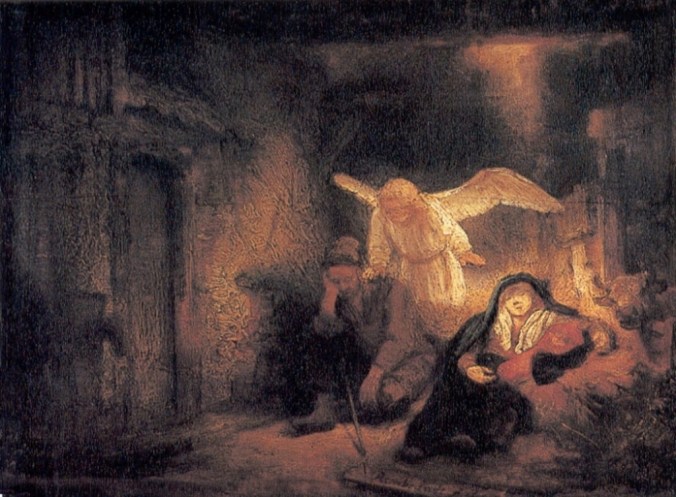




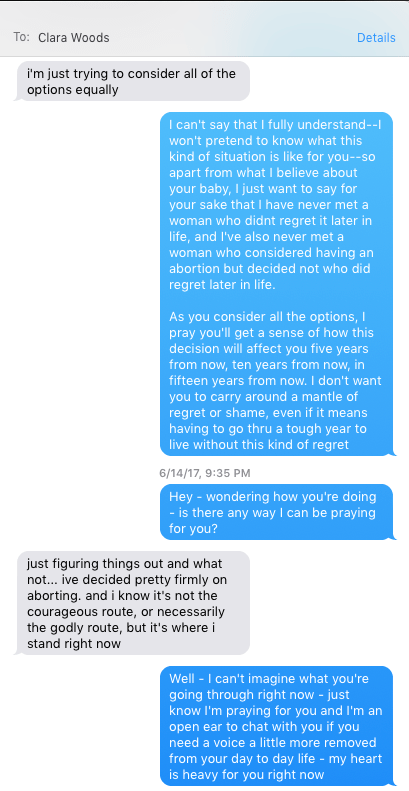
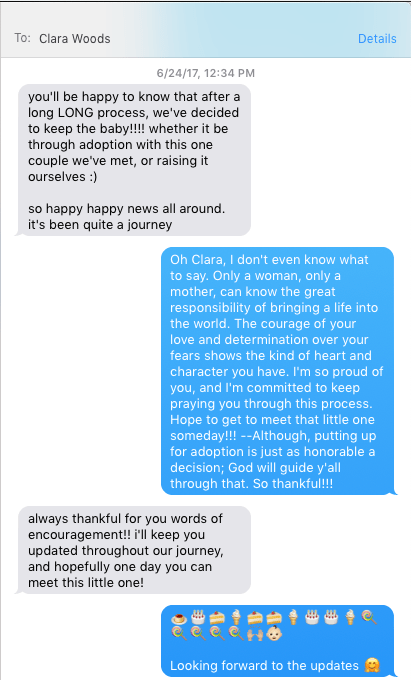



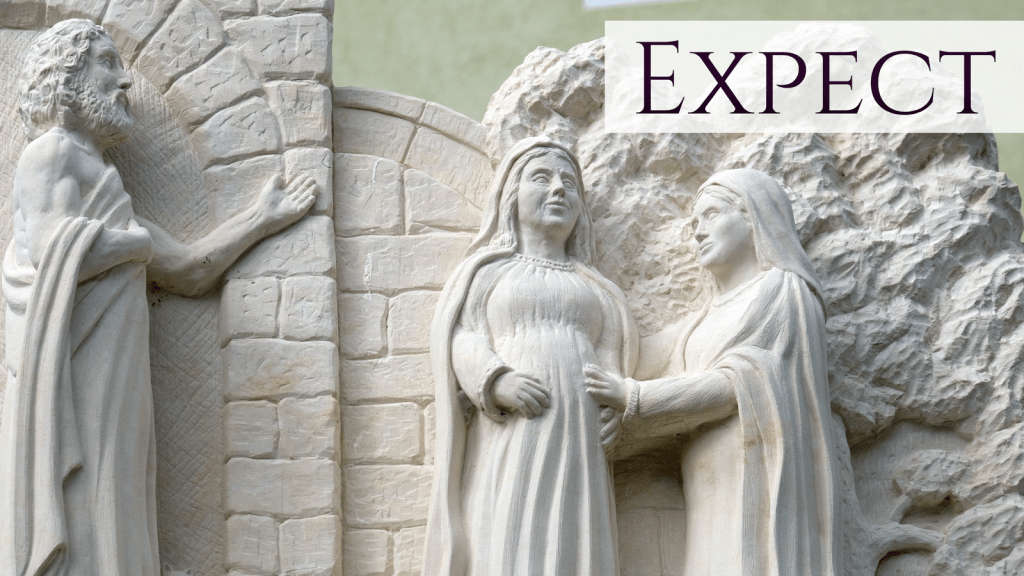


 Enter the Story