Advent, Day 5: Prepare

Now while Zacharias was serving as priest before God when his division was on duty, according to the custom of the priesthood, he was chosen by lot to enter the temple of the Lord and burn incense…And there appeared to him an angel of the Lord” (Lk. 1:8-9).


Waiting. Remembering. Preparing. Such was the life of Zechariah the priest. Waiting—because it was still “in the days of Herod, king of Israel” (Lk. 1:5). As long as Herod was Israel’s king, Israel’s King had not come. Remembering—because that was his priestly duty. The priests were tour guides of Israel’s memory. But Israel’s memory was not a museum. Israel’s memory was not only filled with all that God had done but also with all God had promised to do. So the priests were called to be the living memory of God’s promised future. They were called to remember, and so prepare.

There are different ways of preparing. It all depends on what future you are preparing for. A person who prepares for a race runs. A person who prepares for a dinner cooks. A person who prepares for a test procrastinates studies. Indeed, some ways of preparing for the future are better (or worse) than others. Martha Stewart once prepared for the future by selling her shares in a stock, for better or worse.

I suppose by a certain stretch of the imagination Zechariah’s preparation was something like Martha Stewart’s. He’d been tipped off. He knew where to put his stock, and where not to. He knew not to put any stock in the kingdom Herod was trying to build and prepared instead for the one God had promised to bring. But how does one prepare for that—a promised coming kingdom?

Jesus once said, “One who is faithful in a very little is also faithful in much, and one who is dishonest in a very little is also dishonest in much” (Lk. 16:10). I suppose preparing for a promised coming kingdom is all about the “little things”, being faithful in the “very little” of today because God is taking care of the “very much” of tomorrow. Believing that God is taking care of the big things frees us to live small lives of everyday faithfulness.

Zechariah lived like that. He wasn’t known around town for much of anything. Just another priest, not even the “high” one. But he was known by God. Luke said he was “righteous before God, walking blamelessly in all the statutes and the commandments of the Lord” (Lk. 1:6). That may not make the headlines in our nightly news, what with all the big and important things being reported, but God took notice. God takes notice of everyone who lives “before God” (Lk. 1:6), who prepares for the future by living for the One who promised to bring it.

If faith were an arrow, it would not be pointing up. That is the popular way to think about faith, likely because up never leads back down to earth, where my boss and my habits live. Faith is far more comfortable in the clouds than it is on Monday morning. But faith is a forward arrow (Heb. 11). It doesn’t point to an ideal. It points to a path. Jesus didn’t say fly away with me. He said follow me. He said, “Lo, I will be with you on Monday” (Mt. 28:20, paraphrased). Faith is found in the “little” things, like my attitude at the office, or at home where only my family and God have to put up with me. That’s where my faith lives, or not. If we are going to prepare for the coming of Christ, it won’t be up there with my exceptions but down here with my rule. It’ll be on Monday. Jesus is coming back on Monday.

Zechariah was caught “walking blamelessly” through everyday life as he headed to the office that Monday morning. You can tell it was a Monday because Luke says “his division was on duty” at the temple (Lk. 1:8). Duty is Monday talk. That day the lot fell on Zechariah to go into the temple to offer prayers and burn incense. And when he did he saw an angel. The angel told him his barren wife would give birth to a son. He was to name him John. It was an exceptional moment. But Zechariah didn’t arrive at that moment because he was having an exceptional day. He hadn’t specially prepared to receive a miracle from God that day. It wasn’t at a healing conference or a prayer retreat. He wasn’t on a pilgrimage away from ordinary life. He was on duty. He arrived at this exceptional moment because he was living by his everyday rule: to be prepared for God to come on any day of the week, especially the first day of the week, even the first workday, should he so desire.


Maybe that’s why Zechariah was chosen to be the father of the prophet who would ‘prepare the way’ for God’s dawning future. Maybe all history was waiting for a father like Zechariah, a man of duty and everyday discipline, to raise a son like John, because John would have a special assignment. The angel told Zechariah his assignment would be to “make ready for the Lord a people prepared” (Lk. 1:17). Like father, like son:

“A voice crying out in the wilderness, ‘Prepare the way of the Lord!’” (Jn. 1:23).
Advent, Day 4: Barren

[Zacharias and Elizabeth] were both righteous in the sight of God, walking blamelessly in all the commandments and requirements of the Lord. But they had no child, because Elizabeth was barren, and both were advanced in years.
–Luke 1:7

Barrenness is of course a fertility problem. Biologically it refers to a womb that cannot support embryonic life. Agriculturally it refers to a land that cannot support plant life. Metaphorically it proves to be a rather mutable word. It was a favorite of the Victorian poet Alfred Lord Tennyson, who spoke of barrenness in a number of applications: barren efforts and barren shores and barren crags and barren lives and ultimately of a barren Death:

Wiser there than you, that crowning barren Death as lord of all,
Deem this over-tragic drama’s closing curtain is the pall.

Lord Tennyson is right. Barrenness finds its way into every nook and cranny of this world and our experience of it. And that is because theologically barrenness is the state of creation this side of exile, the world East of Eden. God’s good world of Genesis 1 & 2 had already gone to seed under the stewardship of his image-bearers in Genesis 3 (cf. Gen. 1:26-28). And now we live, it seems, in two worlds, God’s world and our world, a world of good and evil.

The world is thus duplicitous in its barrenness and beauty, its grandeur and terror, its tranquility and violence, its capacity to provide for the unseen sparrow and its capacity to turn to ice. We can neither escape the echoes of heaven nor the shadows of hell. Creation is groaning in both labor and suffocation, new births and burials by the minute, a sign (that is more than a sign) that Mother Nature is ever losing her battle with Father Time. Every birth certificate already shares its name with a death certificate. We live in a world and in bodies and in communities that simply cannot adequately support life.

Every home, so rich with memory, will slowly grow empty and eventually the nest will be left all alone. No more children giggling their way into the master bedroom on Saturday morning. No frenzy of life in the kitchen on Thanksgiving Day frantically filling every dish and basket and platter with an attempt to keep the past alive. No one to say “Mom” or “Dad” or “You’re grounded!” or “Pass the jam”–-just the occasional “Mr.” or “Mrs.” when the phone rings. Then calls come only for “Mrs.”, with condolences. Then the phone just stops ringing. Life inside the walls gives way to a damningly exact proportion of grief. But soon no one is even left to cry. What was once home to a family will eventually house only an empty memory, maybe a few moths. The world is our womb, and it is barren, every life a miscarriage.


But there is something hopeful in all this, because we were not created to live in such a duplicitous world and to be such duplicitous creatures. The world was made to be good and we were made to be like God (Gen. 1). Would we really want God to preserve everything as it is, when the world is full of evil and we are full of godlessness, when nature is amuck with “natural” disasters and we will all die of “natural” causes, unless something “unnatural” kills us first? Would we not rather God burn the evil away and flood the void with light? Perhaps the sign of the times, then, is not that death is the conclusion to all human life but, more precisely, that death is the conclusion to all human evil. Indeed, “the wages of sin is death” (Rom. 7).

But our sin and death has not deterred God from finishing what he has started. He is still committed to making the world to be good and making us to be like God. We just have to be emptied of life, such as it is, before we can be filled with life as it will be. Nobody plants flowers in a bed of weeds or a thicket of thorns. Before there can be new life, there must be death. In this way, barrenness is about new beginnings.


Barrenness is not only the state of things after everything dies. It is the state of things before everything lives. Indeed, a womb must be empty before it can be filled with life, just as creation was formless and void before it was filled with light. But God not only filled the void, he created it (Gen. 1:2). He did not just hurl the world into a space sufficient to sustain it. He created it as a barren womb, a space he would himself have to fill in order for it to be filled with Life. Apart from him this world would only inevitably return back to its original, all-consuming barrenness, but this world is not apart from him—because Christmas. Because God was born into this world, this world can be born again. Our barrenness is not a post-apocalyptic wasteland but the womb of new creation. Emmanuel—east of Eden.

I used to think, wherever you find Jesus, there you will find no misery. But I’ve learned over the years it’s just the opposite: Wherever you find misery, there you will find Jesus. He says as much in some rather harrowing words about the sheep in his fold and goats in high places (Mt. 25). Emmanuel means God has come to us in all the barrenness of our exile, not that we have gone to him in all the grandeur of his celestial paradise. We will never find God in heaven because God has found us on earth, and it is here that heaven is coming (Rev. 21-22): here, in barren places; here, with broken people; here, where God is.


And it has always been so. God comes where the efforts are barren and the ground is chapped. Slaves in Egypt became a nation in the desert. God had come. Out of barren wombs the child of promise is born to Sarah, the child of prophecy to Elizabeth, the “Voice crying out in the Wilderness” born to a father who could not speak. God had come. Out of nowhere the substitute came to Abraham for his son on Mount Moriah. Out of the Virgin the Substitute came to Israel for all sons on Mount Calvary. God has come.

And God is coming again. Isaiah says we’ll know it is God because the cracked desert floor will begin blooming like a daisy field in springtime; the groaning ground of the curse will suddenly burst into song (Isa. 35). Scorched war fields will become spring-fed gardens (Isa. 58); swords and spears will be beaten into the shape of life and kept in the barn (Isa. 2). He said that lions and tigers and bears would go vegan and siesta with lambs and yearlings (Isa. 11). There will be life where there could otherwise be no life, peace in a world of unrest, a symphony filling canyon winds. Paul says we’ll know it is God because when he comes he will lay death down to sleep, pray the Lord its hell to keep. We’ll wake up one day without aching joints and pressing deadlines. We’ll see mirrors we’re not ashamed of (1 Cor. 15).

John says we’ll know it is God because of what happens to the brokenhearted. The little boy whose dad was sent home in the form of a flag, the young mother of that boy looking helpless at his searching eyes; the little girl who never wore white. We’ll know it is God not because the brokenhearted will suddenly stop crying but because their tears will be wiped away (Rev. 21:4). They will be touched by a real Hand and there will be a resurrection of real hands. Those searching eyes will find what they never stopped looking for. It will be like a world ruled by the real religion that James talked about (Ja. 1:27).

John also says we’ll know it is God because it will be like a Bridegroom and a Father and a Son and like a world full of siblings (Rev. 21-22), like wedding reception and a family reunion all at once (Rev. 19:6). It will just be a mess of an overflow. Loneliness won’t fit in even a crack on the floor. There will be no storm shelters or panic rooms, no sirens or seatbelts, no temples or mosques—“And I saw no temple in the city, for its temple is the Lord God the Almighty and the Lamb” (Rev. 21:22)—no closed countries of fleeing families—“for the kingdoms of the world have become the kingdom of our Lord and of his Christ, and he shall reign forever and ever” (Rev. 11:15)—no abortions, no greed or grudges, division or divorce, no partisanship, no voting booths, no border patrol, no propoganda, no child soldiers, no father soldiers, no midnight calls, no shame, no shadows, no more goodbyes: only God, only Light, only peace, only joy, infinite joy drowning the void beneath the weight of the “glory of the Lord that fills the earth as the waters cover the sea” (Isa. 11:9; Hab. 2:14), and us—with a Table there at the center to keep the past alive for good (Rev. 21:21-23).

When Christ comes, he comes to dethrone the one called “barren Death” crowned “lord of all.” The crimson of his crown will touch every tomb and burst forth in a bloom of roses. For He is the “firstborn of creation” (Col. 1:15) and therefore the “firstborn of the dead” (Col. 1:18). And he will again descend into this barren womb of creation, this time to bring forth life in an unbound abundance. When “the Lord descends from heaven…the dead in Christ shall rise” (1 Thess. 4:16). And on that day, the world will be discovered as an ultrasound devoid of any dark, as we all are born again into the womb of eternal life, together with the eternally Begotten Son of God. No more miscarriages.

When he comes—he is coming!

Advent, Day 3: Liberation

“In the days of Herod, king of Judea, there was a priest named Zechariah, of the division of Abijah. And he had a wife from the daughters of Aaron, and her name was Elizabeth” (Luke 1:5).

It is “In the days of Herod, king of Judea” that the Gospel narrative begins (Lk. 1:5). It’s a historical footnote for the modern-day reader, but for Elizabeth and Zechariah, Mary and Joseph, the shepherds in the field and the sheep and the (I-don’t-know-maybe three) wise men, as long as Herod was considered the king of Judea, the true King of Judea had not yet come.

Herod was a king in the way Moses might have been king had he never met that burning bush that spoke his name. Moses was born to a family of Hebrew slaves but through a strange series of events was adopted by a family of Egyptian overlords. In particular, the daughter of Pharaoh, who happened to be the wealthiest and most powerful man on the planet, took him in as her own at a time when all the other little Hebrew boys were being tossed out. Not only was his life spared, but he now stood in line to someday potentially being put in charge of some region of grandpa’s empire, perhaps the region where all the Hebrew slaves were living, slaving. He looked like them, after all.

In that case, he would have been a Hebrew “king” over Hebrew slaves but ultimately under the rule of Pharaoh. Herod was something like that: a Jewish “king” over a predominantly Jewish region but ultimately under the rule of Caesar.


But let’s just say Herod was one chopstick short of being a fully functional human. For example, of his many wives, Mariamne I was his favorite—until he murdered her. And when he was first appointed king over Judea, he made his most respected brother the high priest in Jerusalem. Makes sense. Then he had him drowned at a dinner party. Also, when the two sons he had with Mariamne I grew up, he promoted them to a track of royal succession. A redemptive gesture—until he had them both killed. He seemed to soften with age and so made his son Antipater the first heir in his will. Then, while lying in his deathbed, he decided, “Ah, what the heck…” and had him killed too. Herod was evil. Then he died.

But before that, there was also that time the [not so] wise men inquired to him—the so-called “king of Judea”—about “the King of the Jews” being born in Bethlehem (Mt. 2:2). Needless to say, there wasn’t enough room in Judea for two kings, so Herod had every male child under the age of two executed (Mt. 2:16-17). And in so doing the “king of Judea” had, ironically enough, followed in the footsteps of the king of Egypt, an apple fallen not far from Pharaoh’s tree (cf. Exod. 1:22). You don’t have to be in Egypt to be in captivity.

So it’s hard to say: did Israel need liberation from Caesar’s captivity or from Herod’s? Was it the ruler without or the ruler within that posed the more immanent threat of freedom? Is it Islamic radicalism or is it American consumerism? Or, for that matter, is it American consumerism or is it my impulsive spending habits? Is it civil strife or the kind I find in my home, or the kind I hide in my heart? Is it sex trafficking in Thailand or is it the international pornography industry, or is it the iPhone industry, or is it the iPhone in my pocket?


The severest form of human slavery on the planet always comes in the form of the human will, the ego’s will: “my will be done.” Luther called it “the bondage of the will.” We all, deep down, have a little bit of Herod in our heart. We all want freedom from sin, except that part of us that wants the freedom to keep on sinning. We want to be healthy, but we don’t want to be “freed” from our habits; we don’t want to not feed our habits. We all want people to just love each other and stop fighting each other, except I don’t want to admit I’m wrong or stop keeping a ‘record of wrongs’ (cf., 1 Cor. 13:5). We all want to stop fighting but none of us are willing to stop fighting back (cf., Mt. 5:39). We all want to do God’s will, except we never want “Not my will…” (Lk. 22:42).

Come give us freedom, Lord Jesus, from death and hell, from hopelessness and fear, liberate us from our enemies and our obstacles. Amen, hallelujah! But don’t save us from our pride and from our selfishness. Don’t offer us liberation from our throne of independence. But there is no other freedom the Gospel offers.

Liberation by means of a cross means the world needs liberated from me, and that I need liberated from me. I need to be raised from the dead, but I first need to be “crucified with Christ” (Gal. 2:20-22). But humans do not typically want this kind of freedom. We want control.


Control feels like freedom because control means “my will be done.” So it feels like freedom to the one who has it, but true freedom does not come at the expense of another’s freedom. Control does. Control is the kind of “freedom” Herod had. Control is the kind of freedom you can have by listening to your inner Herod. Pharaoh had freedom like that. And God had to rescue His people precisely from Pharaoh’s freedom, and now he would have to rescue His people from their own “king’s” freedom.

In Paul’s language, that inner Herod is called “the lusts of the flesh,” which always stands in opposition to the Spirit lusts within us (Gal. 5). You are home to a civil war. The inner Christ and the inner Herod are at war for your freedom, for everyone’s freedom. Paul says “It was for freedom Christ has set us free; stand firm therefore, and do not submit again to a yoke of slavery” (Gal. 5:1). The yoke of slavery, or the lusts of the flesh, inhibits anyone from living in freedom (“sexual immorality, impurity, sensuality, idolatry, sorcery, enmity, strife, jealousy, fits of anger, rivalries, dissensions, divisions, envy, drunkenness, orgies, and things like these”), while the yoke of freedom, or the lusts of the Spirit, enables everyone to live in freedom (“love, joy, peace, patience, kindness, goodness, faithfulness, gentleness, self-control”).

The Spirit lusts to give. The flesh lusts to take. The Spirit lusts to make us like Christ, so that others can be free of our tyranny. The flesh lusts to make us like Herod, so that others will live in our captivity, or wishful thinking at least. The Spirit lusts to free us from our slavery to self-service, the flesh lusts to “liberate” us from the freedom of self-control, which is the defining fruit of spiritual freedom. Self-control is the truest mark of freedom because the “self” is that little inner high-chair tyrant, Herod, that needs to die. Self-control starves your inner Herod. Faith in Christ means “I am crucified with Christ” (Gal. 2:20). Self-control in the Spirit means “I die every day” (1 Cor. 15:34).


So perhaps today we could dare to ask ourselves: Who is living under the burden of my control? Do people feel free around me or do people feel the need to live up to my expectations, my will? Does it feel like “the days of Herod” around me—or does it feel like Christmas?

Truly He taught us to love one another,
His law is love and His gospel is peace.
Chains he shall break, for the slave is our brother.
And in his name all oppression shall cease.
Sweet hymns of joy in grateful chorus raise we,
With all our hearts we praise His holy name.
Christ is the Lord! Then ever, ever praise we,
His power and glory ever more proclaim!

Advent, Day 2: Remember

[The following reflection was written a year before my grandfather died.]

“Inasmuch as many have undertaken to compile a narrative of the things that have been accomplished among us, just as those who from the beginning were eyewitnesses and ministers of the word have delivered them to us, it seemed good to me also, having followed all things closely for some time past, to write an orderly account for you, most excellent Theophilus, that you may have certainty concerning the things you have been taught” (Lk. 1:1-4). 

Barney: “Have you seen my shoes? I need to put them on before I go home.”
Me: “You are home, Granddaddy.”
Barney: “No I’m not. This is just where I’m staying until I go!”
Me: “But… I see…”

[So I helped him find his shoes.]

~ A conversation with my grandfather

My grandfather was a minister for 64 years. He began showing signs of dementia many years ago. Since my grandmother passed, his mind has been slipping more rapidly into the void. Watching his decline, I have learned that the world of humanity consists in memories. I’ve also learned that memories are married to names. When one is lost, so the other, and whatever piece of the world went with them.

Of all the names that have fallen into that inglorious abyss, mine included, it was saddest to see my grandmother’s go. Never again will I get to hear the story about the first time he saw her, standing on a sidewalk in a white dress: “She looked like an angel.” Never again will I get to see her memory become wet in his grieving eyes only to be consoled back into laughter by yet another moment shared still in his mind. She was always visible as a glow in his face, even under the hanging weight of his grief. But now there is neither glow nor grief. That part of his world and that part of his face are gone. And I suspect, were it up to him, he would welcome the grief back in endless waves if only to salvage a few glimpses of his long lost angel, forgotten at sea. But she is lost to him.

But she is not lost. And she is not lost to him forever. Because the one Name that still puts color in his face and fills his mouth like lead is the Name of the One whose hands first joined them together. And His grieving hands are as stubborn as nails that refuse to let go of the dead. So my grandfather may not have my grandmother’s hand anymore to hold, but he still daily folds his hands in prayer—and he has never forgotten in whose Name his prayers are made. That world still belongs wholly to him, and he wholly to it.

From this vantage, he has forgotten nothing. For those who remember where they are going, not even a single drop of the past will be lost. 


It was this insight that prompted Luke to compile the memories of those who had seen Jesus with their own eyes. He wanted to offer the world a composite memory of the Man who carries the future in his hands, indeed all time in his Person (cf. Rev. 1:1-8). So sharing a secondhand memory of Jesus can lead to a firsthand encounter with Him. All you need is his Name (cf. 2 Cor. 1:20; Mt. 18:20). Jesus’ Name is God’s #📞 (Acts 2:21). That shouldn’t be too hard to remember.

Jesus is the eternal Word of God who became flesh and blood (Jn. 1:14) in order to speak in a language we could understand. The infinite and eternal God became finite enough to fit in a manger and temporal enough to die on a tree. But neither time nor space nor death could ultimately contain him, and upon his return to His Father, our Father in heaven, the Spirit of God was poured out in a global flood, so that “whosoever calls on the Name of the Lord shall be saved” (Acts 2:21).

Jesus stands between all time and eternity, holding all things together, calling all things to himself. So there is nowhere and no-when that God is not present in the person of Jesus Christ. He is the Presence without which there could be no presence, the Being without which there could be no beings, nor human being, the eternal reality in which we participate on borrowed time and toward which time will eventually terminate, or consummate—“for from him and through him and to him are all things” (Rom. 11:36).

Unlike every other person, Jesus does not exist merely as a series of moments in time, each one dissolving into the next until all is dissolved into death. This is how we experience the world and the world experiences us. Over time, our memories fill our minds like a ghost towns, haunting us, taunting us, giving form to our voids and voice to our groans.

But a memory of Jesus is a memory of the One who is always and everywhere present. To remember anything about what Jesus has done in the past is to know something about the One who is present, who is with us and with God, the One who is “God with us”—Emmanuel. Jesus holds the future and is seated beside you—with you, with God—at present. Reading Luke’s memories of Jesus is like children hearing their aging parents tell stories about one another, about the days “long before y’all were born.” They share memories from their shared past in a way that enables their children to share more of their life with them at present. Shared memories are the means by which we all get to know each other more and more.

So Luke sits at the foot of the bed like a child and collects all the memories he can get his hands on and then weaves them together to share them with us, and so reveal to us, and remind us, “all the things that have been accomplished among us” (Lk. 1:1). And to be reminded of what the Eternal God has accomplished among us is to become part of the “us” for whom and among whom Jesus has accomplished all the things. And through these memories we’ll get to share more of Jesus life in our minds and hearts today as we await his arrival tomorrow. Until then, we will ‘always remember to never forget’: he is forever Emmanuel.

“Behold, a virgin shall be with child, and shall bring forth a son, and they shall call his name Emmanuel, which being interpreted is, God with us.

Matthew 1:23

Advent, Day 1: Wait

2025 Advent Reader

ad·vent / ˈadˌvent: the arrival of a notable person, thing, or event; to come to

“He who testifies to these things says, ‘Surely I am coming soon.’
Amen. Come, Lord Jesus!
The grace of the Lord Jesus be with all. Amen” (Rev. 22:20-21).


The Bible concludes with this great historic cliffhanger. The first time Jesus came to this world he ensured us he’d come again to finish what he started. We are left on Scripture’s last page with two basic claims about the course of history and the fate of this world: Christ has come. Christ will come again. We are, at present, between the times. History has taken the shape of a promiseand faith has taken the shape of waiting.

Jesus once said, “Be like those who are waiting for their master to come home from the wedding banquet, so that they may open the door to him at once when he comes and knocks. Blessed are those servants whom the master finds awake when he comes” (Lk. 12).

Waiting is hard work. Jesus described it here as the kind of work that allows us to hear, the work of listening intently. It’s like children with their ears pressed against the bedroom door on Christmas morning waiting for mom and dad to get out of bed, (miraculously) quieting themselves enough to hear movement on the other side. The blessing in Jesus’ parable comes to those who proved to be waiting for their Master simply by opening the door upon his arrival—they could hear movement on the other side. This kind of listening is hard work because our kind of world is hard of hearing. 

We live loud lives: wake up, screen on, eat and run, text and drive, toil and labor, bounce around, fast food, back home, screen back on, plate on lap, back to bed, earbuds in, wake up—rinse and repeat. We have one-click shopping. Pay phones have gone the way of the dodo. The Internet doesn’t make that intergalactic fax machine noise anymore. No waiting necessary. Just Google it. 

Now, it could be that all this on-demand efficiency is evidence of a culture that has discovered all that satisfies the longings of the soul, and so made satisfaction widely and immediately available. Or it could be just the opposite. It could be an indication that we have found exactly nothing that satisfies our longings. It could be an indication that we’ve just resorted to an abundance of stuff that does not satisfy. It could be indicative of the fact that we have mastered the art of being, in T.S. Eliot’s words, “distracted from distraction by distraction” (“Four Quartets”). 

We are occupied and preoccupied with stuff that keeps us busy enough to never have to confront the hollowness we discover in the silence, when we quiet ourselves enough to listen for any movement from God from the other side. Perhaps we’re afraid to press our ear against the door, because the first thing you inevitably hear in the silence is silence. When confronted by an outer silence we are in turn confronted with an inner disquietedness, that restlessness that drives us to all our clinging and clanging and banging around. The sound of silence, for some reason, feels like alienation, like we are alone in the cosmos, like a Presence is missing from our presence.

It’s hard to have the faith of a child these days. It’s hard to believe that God will ever awake from his slumber. And so any encounter with the silence leaves us to anxiously wonder if, in fact, there is nothing happening on the other side, if there is no one coming from the other side. So we fill our lives with things do, places to go, a world to produce, a world to consume, a world to possess. And so in our efforts to consume an abundance of satisfaction we are consumed by an abundance of distraction–anything to avoid listening to the silence.

But shouldn’t the Church, of all people, have a different response to the silence? Shouldn’t the silence of Good Friday shape our longings more than racket of Black Friday?


The slaves in the parable who opened the door did so because they heard the knock, but the reason they heard the knock is that they were “waiting for their Master to return.” It’s no surprise that the secular world celebrates our Christmas but wants nothing to do with our Advent. But there is no Christmas without Advent anymore than their is Easter Sunday without Good Friday. Whatever else Christmas is about, Advent assumes it is about two things that our culture knows nothing about: having a Master and having to wait. Indeed, Christmas is only worth celebrating because Christmas is coming again. And if it is not, if He is not, we should simply find a new home where we can sleep in the master bedroom, so we can be comfortable as we grow old. 

But He is coming again. There movement on the other side. We just need to begin to listen to our deepest longings, the longings Christmas taught us to hope for. But daring to long for hope that long, that wide, that deep takes some intentional cultivation, entering fully into the festivity of the Advent season, so that the naive and childlike hopes of the Christmas promise can well up without getting squashed down by our inner scrooge or drown out through the remote control. We have to allow the grandiosity of the Christmas promise, and our longing for it, to move our ear against the door to wait for a movement from the other side almost too good to be true, so good that it no one could bring it but God alone—for universal peace, for eternal joy, for a family embrace across all tribes, tongues, and nations, for the reunion of all lost sons and daughters, for restoration of a broken world and resurrection of broken bodies: thy kingdom come, thy will be done, on earth as it is in heaven… 

We have to allow that all-embracing ache that lies at the center of human experience to reveal its true form as the heartache of our eternal homesickness.

If we allow that, however, we are bound by our heartache to resign ourselves to hope, because we do not have the raw materials within ourselves to satisfy that longing, and neither does the whole world and all that is in it. The only possible comfort for an eternal homesickness depends on the correspondence of an eternal counterpart on the other side of the door. It depends on something or Someone no less powerful than the power of all creation and nothing less loving than the source of all love. This is, to be sure, nothing less than the precise claim of our Master, who came to lead us—like little siblings on Christmas morning—with an eternal longing to press our ear against the door to listen for a movement “coming down out of heaven from God” (Rev. 21:2). 

For to us a child is born,
to us a son is given;
and the government shall be upon his shoulder,
and his name shall be called

Wonderful Counselor, Mighty God,
Everlasting Father, Prince of Peace.
Of the increase of his government and of peace
there will be no end,
on the throne of David and over his kingdom,
to establish it and to uphold it
with justice and with righteousness
from this time forth and forevermore.

~ Isaiah 9:6-7

So sit tight, sit still, and lean in to Advent this year. We need it just as much as we need Christmas, because without the waiting—the listening—of Advent, we may never hear Christmas when it comes.

Even so, come quickly, Lord Jesus.

advent-wait-for-it

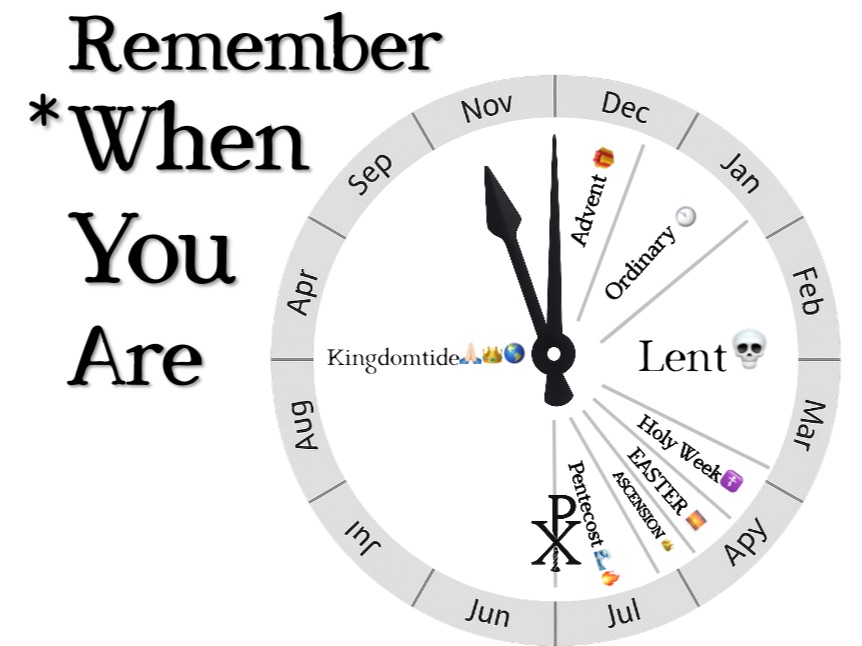
Remember *When* You Are

ad·vent / ˈadˌvent: the arrival of a notable person, thing, or event; to come to


“From of old no one has heard or perceived by the ear, no eye has seen a God besides you, who acts for those who wait for him” (Isa. 64:4).

It’s almost time for Advent. Advent is both a matter of history and a matter of festivity. It is, in the first place, a matter of history because before Advent is an annual holiday for Christians across the world it is the single event of Christ coming into the world: the Incarnation, the embodiment, of the Son of God. Christians celebrate Advent annually not only to remember Christ coming into the world but also to anticipate the Christ coming into the world again. The first Advent came with the promise of a second Advent. We can greet an otherwise uncertain future with a certain hope that Christ will arrive in there, then, to receive us, dead or alive, into his eternal life. The Church’s Memorial Acclamation thus resounds daily in worship services across the globe: Christ has died! Christ has risen! Christ will come again! Christian memory is at once a form of anticipation. History has taken the shape of a promise.

Advent is the season set aside for waiting, the time we remember how to anticipate God’s promised future by remembering how God kept his promise to usher in a new future through his Messiah, our Lord Jesus Christ. We remember that our God is a God who delivers on his promises, even if it means being delivered “outside the inn,” even if it means being born in a barn and laid in a manger.

Thus the festivity begins as we reenter the story, shepherds in the field, angels in the sky. Salvation history is also a matter of festivity. Christian festivity is the embodied memory of the community of faith. Each year we reenter the live nativity of the liturgical calendar and decorate the world with salvation history, singing festive hymns that fill the air with hope. Our public festivity reminds us and each other and the whole world the story its and we’re a part of, it and we belong to, and so situates and (re)orients us in the actual history in which we are living, in which the world is spinning, the world where Christ has come, where Christ is coming again.1


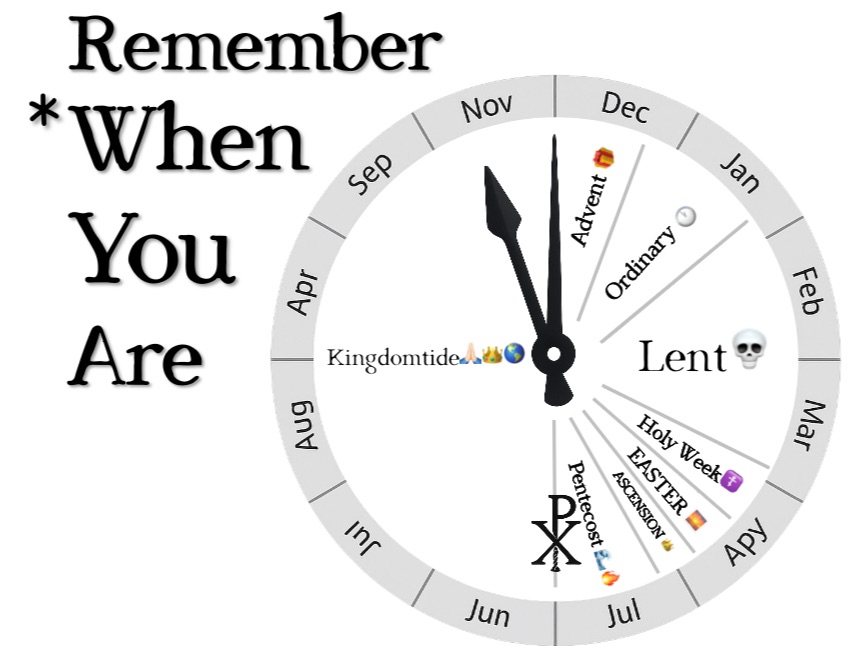
Advent marks the beginning of the Christian (liturgical) year. The birth of Jesus doesn’t begin on Christmas Day any more than the Bible begins with Matthew’s Gospel. The birth of the eternal Son of God into the mortal human family was the fulfillment of a promise in history long before it was an event in history. So the Christian year begins with a longing for Christmas. That is what Advent is all about. It’s about cultivating our longing for the coming of Jesus.

The most basic meaning of the word advent is to ‘come to’, not simply ‘to come’ but specifically to ‘come to‘. It implies a specific place where anticipation is met with arrival. During the season of Advent, the Church actively waits for Christ to come again into our world by waiting on Christmas to come again into our world. If Christmas is the time for gifts and celebration, Advent is the time for restraint and anticipation. We are ushered into this season not with the rush of Black Friday traffic but with the Silent Night of Israel’s longing:

O come, O come, Emmanuel
To ransom captive Israel
That mourns in lonely exile here
Until the Son of God appears
Rejoice, Rejoice, Emmanuel
Shall come to thee, O Israel 


This all begins the fourth Sunday before Christmas and concludes on Christmas Day, which is the Church’s New Year’s Day. A few months after Christmas the Church enters the season of Lent, which culminates in the Passion Weekend (the Paschal Triduum), concluding on Easter Sunday. Forty days after Easter is the celebration of the ascension of Jesus to his throne in heaven. And finally, fifty days after Easter, the Christian festive year concludes with Pentecost, remembering the day the Holy Spirit flooded the earth and filled the Church.

To remember the event of Pentecost and the story that led to it is to understand what time it is in salvation history right now, at present. It is our orientation for everyday life. God’s Spirit has been poured on all flesh and the Church has been sent as witnesses of Jesus Christ so that those who believe may be saved from their sins and filled with the Spirit. The Church’s festivity is matter of Christian identity! And it’s one way that we bear witness to the world about the identity of its and our Lord. Indeed:

For Christ, our Passover lamb, has been sacrificed. Let us therefore celebrate the festival, not with the old leaven, the leaven of malice and evil, but with the unleavened bread of sincerity and truth.

—1 Corinthians 5:7-8

And so it is time. It’s time to wait for the God “who acts for those who wait on him” (Isa. 64:4). It’s time to enter again the world of waiting, the world of promise, the world where God has come with a promise to come again, and to bring with him an incomparably greater world—this one.


*FOOTNOTE

1In the Old Testament, God commanded his people by Law(!) to ‘reenact’ salvation history annually through a series of seven festivals, from the Passover to the Feast of Tabernacles, with feasts and community celebrations that cultivated the embodied hope in each generation (Exod. 23; Deut. 16; Lev. 23). It was this living memory of a saving-God that helped each generation of a needing-saved people find hope in the God of their salvation. All the Jewish festivals about God’s past salvation lead up to the Day of Atonement—God’s present salvation—so that each successive generation would know the God who atoned for their sins was the Same “brought them out of the land of Egypt, out of the house of slavery,” who led them through the wilderness and gave them his Law in Sinai. Remembering God’s salvation in the past is the basis for anticipating God’s salvation in their future—in their annual pilgrimage toward Atonement. 

The Church has adopted the wisdom of remembering from God’s Law and structured its annual calendar around salvation history under the New Covenant: the birth, life, death, resurrection, and ascension of Jesus and the sending of the Holy Spirit: this is our salvation. Our festivity thus brings us in feasts of nativity and angels singing to remember God’s saving act of being made flesh and tabernacling among us!